Think back to your favorite childhood memory of play.
Were you outside? Probably.
Riding your bike? Maybe.
Were a bunch of adults telling you what to do? Definitely not.
Do your children have at least one hour per day to play whatever they want, (without a bunch of “be careful” or “get down from that” warnings?) If not, today is your day to start!
Children need play for a variety of reasons. They don’t just want to play, they actually need it to develop properly into happy, healthy adults.
The latest guest on the Screen Less Play More Podcast has SO much amazing information and advice on why play is vital to children, and how to incorporate more into our lives! Deb Lawrence is the president of The International Play Association, USA, and she knows how to tell a fantastic story! Deb tells us that the best thing you can do for your children is completely free, requires no pricey uniforms, and can happen absolutely anywhere (no annoying carpools or commutes necessary!)
Play shapes a child’s future
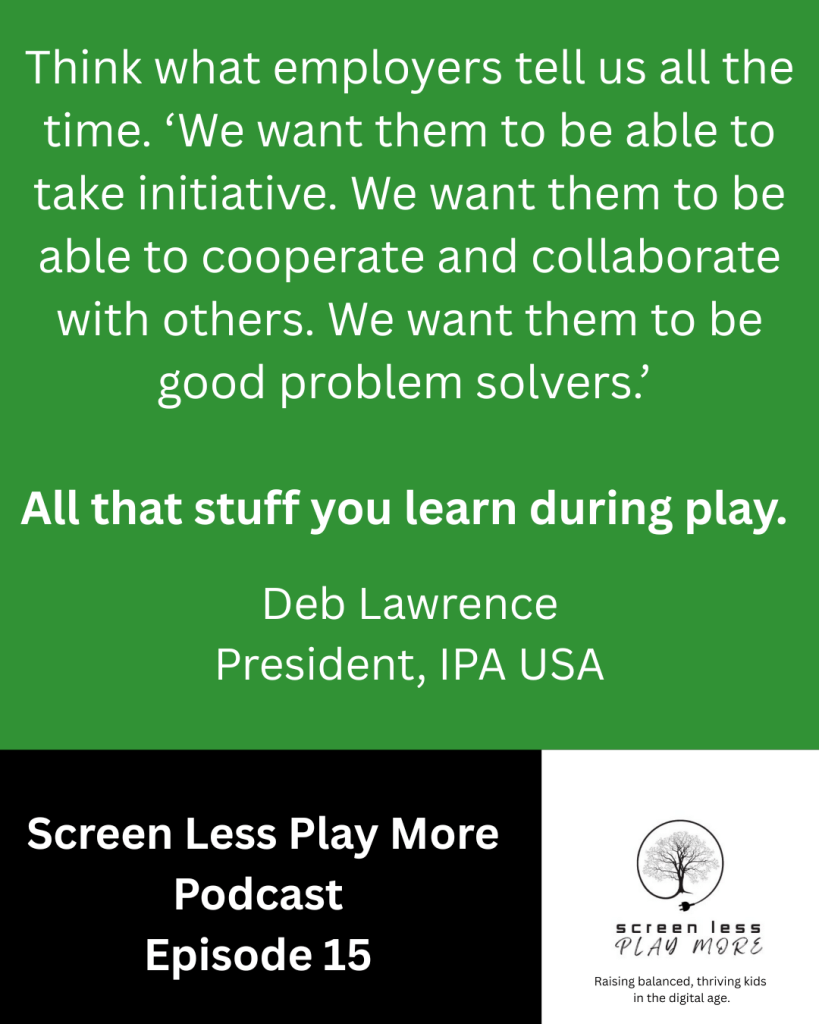
Deb Lawrence tells Screen Less Play More, “Think of what we want the future worker to have. Think of what employers tell us all the time. ‘We want them to be able to take initiative. We want them to be able to cooperate and collaborate with others. We want them to be good problem solvers. We want them to have good communication skills.’ All that stuff you learn during play.“
Whether children are playing in a group, or by themselves, they are constantly learning. Every different stage of play development is beneficial.
Deb Lawrence explains that children start in “solitary play where they just play by themselves, and that’s typically infants and young toddlers. And then they move into parallel play where they may be playing by someone but not with someone. And then they move into associative play where maybe they’re sharing materials, but they’re not coordinating yet. They’re not collaborating on what they’re gonna build. And then they move into cooperative play. And that’s where they’re assigning roles and they’re cooperating. Well, once you get to cooperative play, that’s the highest form of play….The phases that they go through are critical to their development. And so you can’t get into cooperative play, the highest form of play, if you haven’t had the solitary play.”
Recess is vital to child development
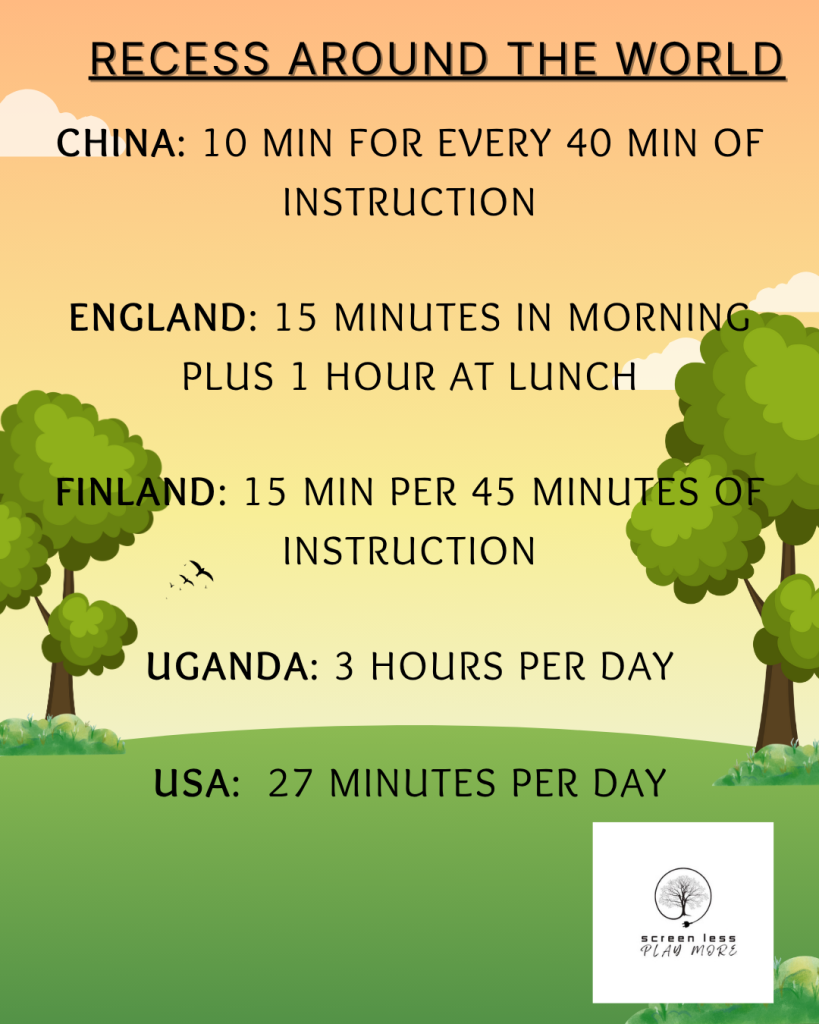
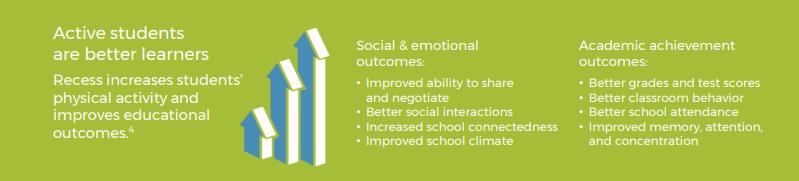
According to the CDC, most school children in the US get only 27 minutes of recess per day. And according to IPA USA, “within the United States, 40% of schools do not provide our children with recess.” We need to change this! Recess is vital to the health and well-being of our children.
“Some schools don’t even have recess because they’re trying to improve their test scores. ….If all you’re focusing on is the cognitive domain of development, then they’re not going to be as efficient in learning,” Deb Lawrence tells our podcast. “I mean, adults, my goodness…We get two 15 minute breaks and a lunch break, but they expect kids to do an hour and a half, or two hours, or six hours of adult led stuff without a break.”
Another problem Deb Lawrence identifies is that, “In some schools, even though they have the recess law, one of the disciplinary measures is to keep kids in from recess because they didn’t finish their work. And those are the kids that need the recess the most, right? Because they need a break. And so it is a dilemma, and parents are the only ones that can identify what is best for their child. And they need to go straight to the school board. And if you get other parents together and you all go to the school board, I promise you something will happen.”
She continues, “Finland has the highest international test scores of any country in the world, and have for decades. And so for every 45 minutes of instruction in classrooms, their children have 15 minutes of recess.”
Make play a priority. It’s that important.
You may be thinking to yourself, “When the heck am I going to make time for free play between homework, soccer, dance class, dinner, and bedtime?” Former podcast guest Linda Flanagan would urge you to reduce the amount of time you invest in organized sports. Hear her amazing interview here. But if that’s not an option for your family, you might think of opting out of homework in the elementary years. Research has shown little benefit to homework, and some studies find it to be harmful. You’ll be amazed how much time that opens up in your day!
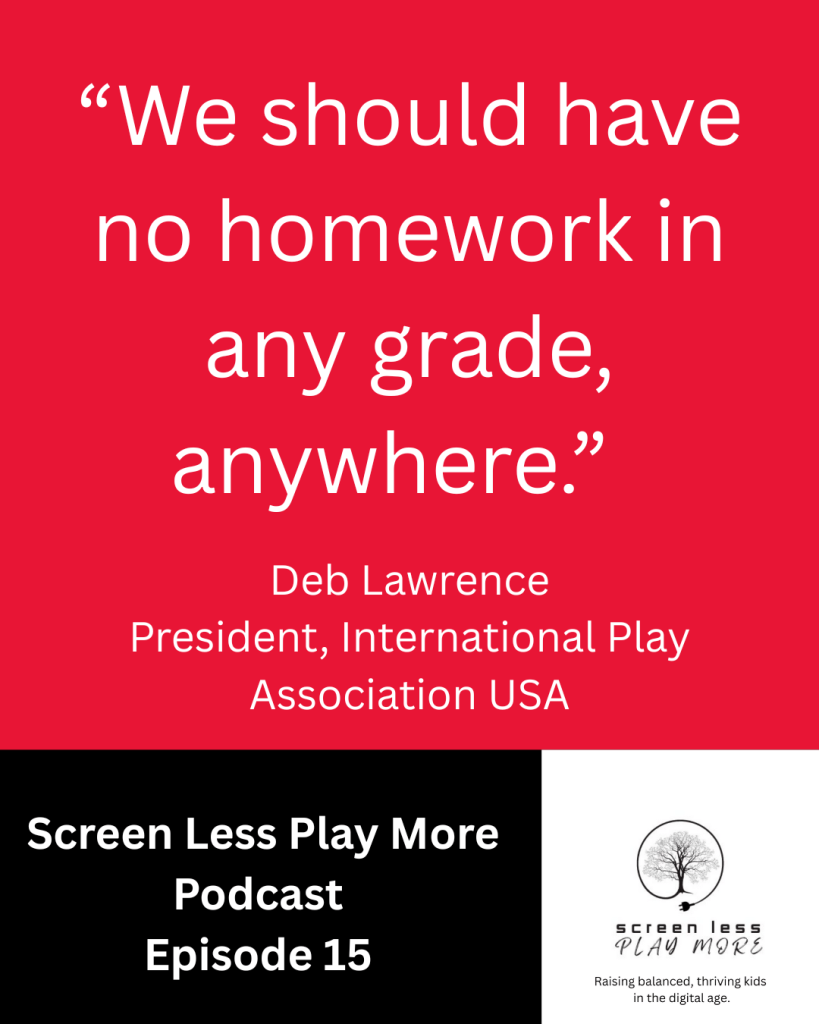
Many play experts, including Deb Lawrence feel there should be zero homework given in elementary school. Instead, after school time should be spent in independent, free play (preferably outdoors.) Our family makes this happen by going to the park after school, or playing in the yard. My kids love to ride bikes, roller skate, wade in a nearby stream, play board games, or read in the hammock. The limited extracurricular activities they do have occur in the evenings and weekends.
Listen to another amazing Screen Less Play More episode about play with expert Sally Swiatek.
Play more, screen less!
One more way to make time for play, is to put aside the screens! Jonathan Haidt, author of “The Anxious Generation” calls screens “experience blockers.” If you’re on a screen, you’re not exercising, or sleeping, or enjoying friends etc. One way our family reduces screen time is through Screen Free Sunday. You can also try more outdoor games, or screen free toys. And don’t forget, that parents need play too! Here are some unique, playful date ideas.
Find out how screens are intentionally designed to addict us in this fascinating interview with Dr. Richard Freed, author of “Better Than Real Life.” He explains the secret science that Silicon Valley is using to hook us all to social media and video games.
More great podcast episodes!
It’s Time To Ban Phones In School | Melinda Murphy | Screen Less Play More Episode 14
The Hidden Dangers of Snapchat, Roblox, and Group Texts | Sarah Gallagher Trombley | Episode 9
My School Banned Phones for The Year, Here’s What Happened | Gilbert Schuerch | Episode 12
How to Be More Engaging Than The Algorithm | Erin Loechner | Screen Less Play More | Episode 2
Kids Are In A Digital Crisis | Kat Zilka of Disconnect | Screen Less Play More Episode 1
Disclosure: I am an affiliate of Bookshop.org and I will earn a commission if you click through and make a purchase
Checkout my Substack!
Snapchat Thought I Was 15. What It Showed Me Was Shocking.
Should I light my child’s iPad on fire, or grind it in the garbage disposal? Asking for a friend…
Why are kids so addicted to screens? Hint: It’s by design
How Money and Mania are Ruining Kids’ Sports
Why is play important for children?