“The Tech Exit” stopped me in my tracks on page 7.
Author Clare Morell explains that we have a metaphor problem when it comes to digital technology. A lot of people think that time limits can mitigate the harms of screens and social media in the same way that moderation can mitigate the harms of guilty pleasures like alcohol or sugar. If you just do less of it you’ll be ok, right?
But Morell writes, “Let’s get the metaphor right. Digital technologies are not like sugar. For the developing brains of children and teens, they are more like fentanyl.”
Yikes.
I’m pretty sure none of us wants our kids on fentanyl.

She continues, “Even a small amount of time on screens creates a strong craving for more. Digital tech generates this craving by stimulating the brain to release dopamine, a neurotransmitter involved in the brain’s reward system. But dopamine doesn’t create satisfaction or lasting pleasure; it only produces ‘wanting’ so that we will repeat that action.”
This explains so many of my seven-year-old’s sobbing tantrums when asked to turn off whatever computer game he’s playing, or when asked to hand over the X-box controller. Modern day games are designed to addict. They’re different than the Nintendo of yesteryear, or the “Oregon Trail” of your third-grade computer lab. This is why our family finally kicked the games to the curb. Much like Morell, we have found that there’s no such thing as “enough” of modern video games to a young mind. They’re always begging for more. So now we use an old school Gameboy, without internet connection, when on a long airplane or car ride. Otherwise, it’s just good old fashioned TV.
Tech Exit: Not All Screens Are Created Equal
During her interview with the Screen Less Play More podcast, Clare Morell explains how screens are not all created equal. “The interfaces of smartphones and tablets are meant to be addictive just by the way it’s easy to swipe between apps. They’re getting these constant notifications, even kind of these apps that are advertised as educational games have all these hits of dopamine. It’s because the whole like experience in the app and on the tablet is incredibly stimulating and it’s overstimulating to a child’s nervous system.” Clare continues, “And it’s because these interactive screens give us feedback and it’s that feedback that makes it so addictive.”
She explains, “A television is very passive. You are just a passive participant watching a program that has a natural endpoint. It’s just Mr. Rogers, 30 minutes, it’s over. So you may get some hits of dopamine while you’re on it, but it is not the same level. It’s not as immersive or as addictive because these interactive screens, games, social media, tablets, smartphones are giving this constant feedback that keeps you going back for more.”
To hear Clare’s two part interview click below:
“The Tech Exit” Shows Us How To Get Unplugged
Are you looking for a way to get your kids unplugged, but you’re afraid that you’ll go unhinged? You’re not alone.
You have probably found, like many, that limiting gaming and social media in your home just makes for constant battles. If you say 30 minutes, they want an hour. If you say three hours, they want five. Luckily, Clare Morell wrote “The Tech Exit: A Practical Guide to Freeing Kids and Teens from Smartphones” and has a better way for us.
She explains that the smart phone is like a drug dispensing machine. She advises, “There are certainly costs to giving up screens, but really the simplest, the most effective, and the easiest and best for yourself in the long term is to just actually get rid of that drug dispensing machine.” I know this sounds terrifying, but hear me out. Step one is the screen detox.
Tech Exit Step 1 – The Screen Detox
Let me assuage your panic by explaining that a detox does not have to mean sitting in a cabin in the wilderness without your curling iron or your latest Netflix crush. You as the parent can still reply to emails, check the news, and ask Google if aliens are speaking to you through your breast pump. Just don’t do it in front of your kids!! For goodness sake, don’t take away Fortnite from Johnny and then sit at the dinner table scrolling Instagram!
Get rid of the addictive tech. Anything with an algorithm or a touch screen. This means social media, video games, computer games, YouTube videos, and anything that starts WWIII when you try to take it away from your kids.
Clare suggests that one of the best ways to start a detox is to go on vacation. Take a fun trip somewhere, and DON’T bring along your tech. Take the lazy days in Hawaii or the long hikes in Montana to explain to the kids why tech is addictive, and why your family is choosing to make a change. This will help ease them in to the concept. And make sure that all of the devices are GONE before the kiddos swarm back into the house.
Once your children are no longer addicted to their devices, you can choose as a family what you would like to reintroduce. As stated earlier, not all screens are created equal. I don’t know anyone who is addicted to watching “Daniel Tiger,” but there’s certainly kids who can’t get off TikTok. You might decide to watch one cartoon per day to give yourself a break. You may decide to enjoy family movie night on the weekends to introduce your kids to the classics you hold dear. (We showed our kids “Ferris Bueller’s Day Off” recently and it was SO fun. There is TONS of cussing in the movie, but it’s an otherwise hilarious ride.) Once you aren’t having constant battles about screens, you can be intentional about your consumption, which often times makes it that much more enjoyable.
Why do a Tech Exit?
What is the point of doing a “tech exit” anyway?
Personally, it makes me insane to constantly bicker with two children about why they should turn off the screen and go breathe air that didn’t come from an AC unit. Your reasons may be different. You may want your family to read more books, or enjoy hobbies, or have the time to learn a new language. Maybe you want to be more intentional with the way you spend your time. Author Clare Morell would argue two main things:
1. Most of the internet is not safe for children and
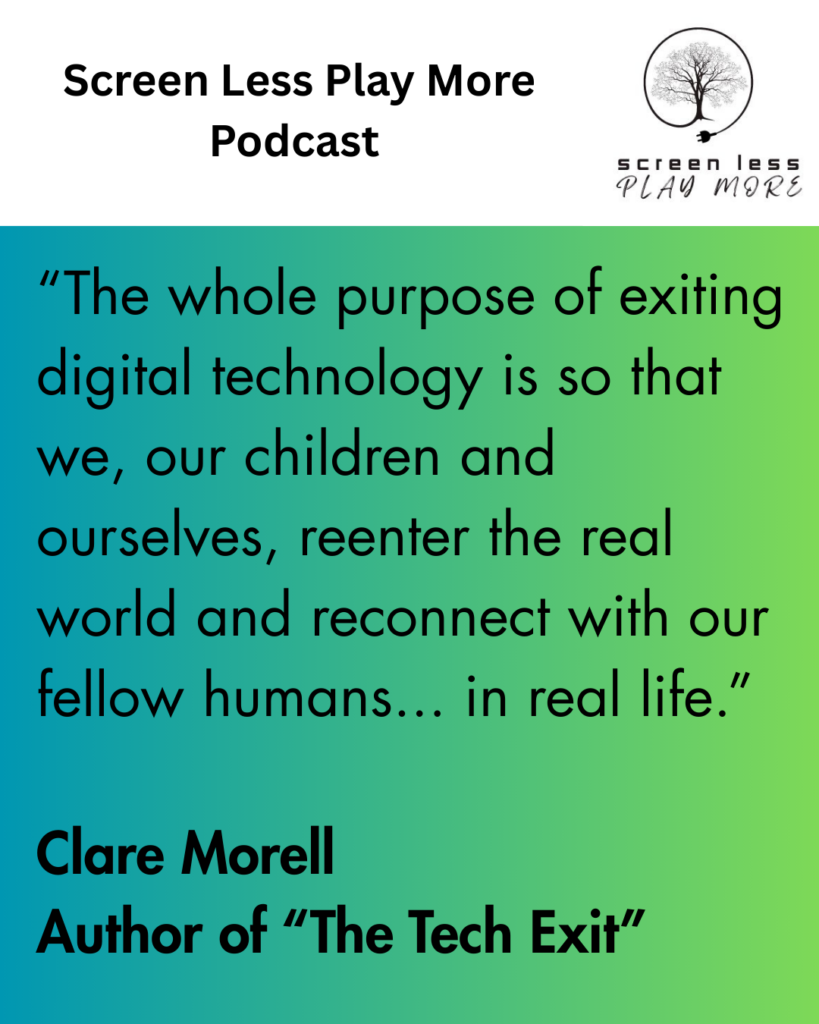
2. Exiting technology gives us the opportunity to reconnect with our fellow humans in real life.
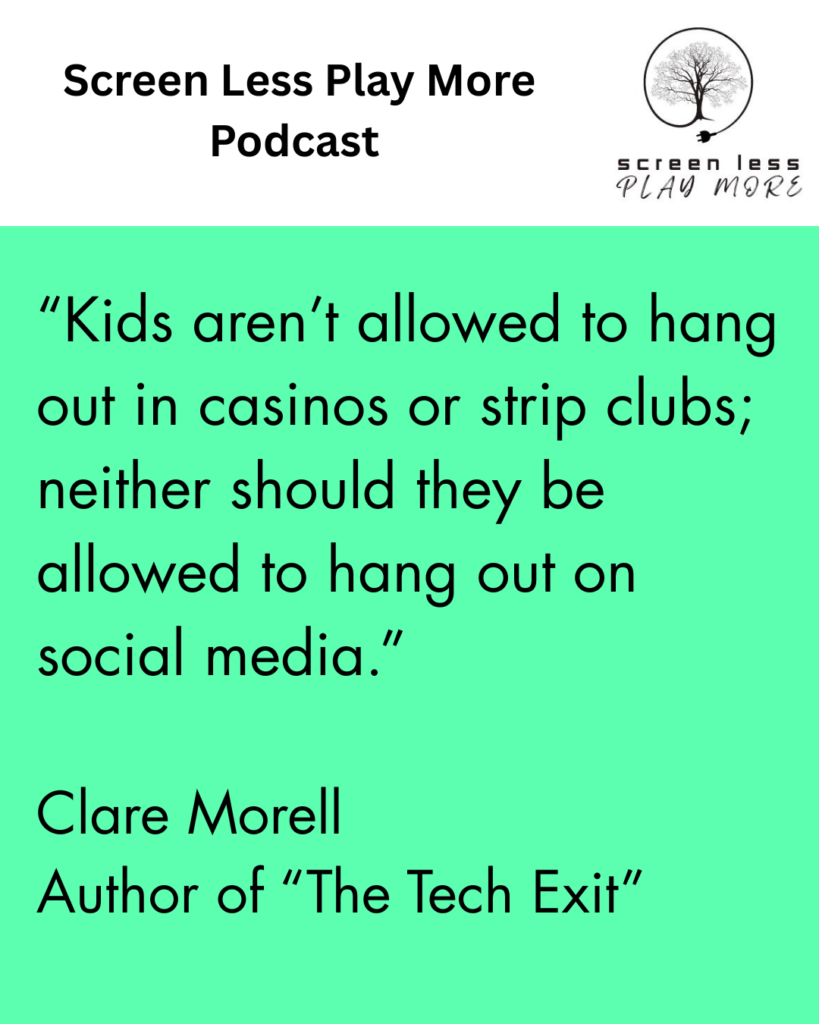
Not only does a “tech exit” give kids more time to play, it also protects kids from the many serious dangers of online life. Keeping kids off social media drastically reduces their exposure to predators, pornography, bullying, extortion, and violent content. Society used to keep kids safe from real world harms in many ways. Alcohol has an age limit, strip clubs have a bouncer, pornographic magazines are behind the counter, casinos throw kids out, and seatbelts are the law. But the internet has no such buffers keeping our kids from developmentally inappropriate or outright dangerous content. Exiting tech completely can be the buffer kids need and desire.
The Tech Exit Acronym
Author Clare Morell makes an exit from technology a little easier with a 5 part process, outlined with the acronym FEAST. The book is full of excellent ideas on how to implement these directives, as well as success stories from families who have excited tech and are reaping the benefits. This is what those “tech exit” families have done to find success in a low tech life:
F: Find Other Families
“They find other families to exit with them and create communities.”
E: Explain, Educate and Exemplify
“They get buy-in from their kids by explaining their rationale, educating them about the dangers of digital technology, and exemplifying healthy tech use as parents.”
A: Adopt Alternatives
“They resist smartphones by adopting alternatives and finding work-arounds.”
S: Set Up Digital Accountability and Family Screen Rules
“They set up digital accountability in their families, disallow private technology, and establish family screen rules.”
T: Trade Screens for Real-Life Responsibilities and Pursuits
“They replace screens with positive real-life responsibilities and activities.”
Where to get The Tech Exit
I hope you tune in to Clare’s excellent and fascinating conversations with Screen Less Play More podcast. I also highly recommend her book which you can get at Amazon or Bookshop.org. I am an affiliate of both and will get a small commission if you purchase through those links, at no cost to you.
If you would prefer to read the transcripts of the episodes, enjoy below!
Smartphone-Free Childhood: Why Screen Time “Moderation” Is Failing Our Kids – Episode 1 with Clare Morell, author of “The Tech Exit”
Is a smartphone-free childhood the key to raising healthier, happier kids?
In this episode of Screen Less Play More, Cynthia chats with Clare Morell, author of The Tech Exit, to explore why screen time moderation doesn’t work—and why parents may need to rethink technology entirely. We break down how smartphones and interactive screens are intentionally designed to be addictive, especially for children, and what that means for brain development, behavior, and mental health.
Clare explains why passive media like TV affects kids differently than interactive screens, how a 30-day digital detox can reset children’s brains, and why it’s never too late for parents to change course. You’ll also hear practical strategies for creating a tech-free family culture, building parent communities for accountability, and choosing safer alternatives to smartphones for kids.
This conversation goes beyond individual parenting choices to discuss how education and open dialogue help kids understand technology, and what parents can do right now to reduce screen dependence at home.
If you’re worried about screen addiction, kids and smartphones, online safety, or digital detox for children, this episode will challenge what you’ve been told—and offer a hopeful, realistic path forward.
🎧 Topics covered: • Smartphone-free childhood and healthy development • Why screen time moderation fails. Screens are a drug dispensing machine. • Interactive screens vs TV for kids • 30-day digital detox for children • Safer phone alternatives for kids • Parenting without smartphones • Building community support around tech boundaries
Perfect for parents of toddlers, tweens, and teens who want to raise kids without smartphones—and without fear.
For discussion guides and resources for “The Tech Exit: A Practical Guide To Freeing Kids and Teens from Smartphones” check out Thetechexit.com
Transcript from Screen Less Play More interview with Tech Exit Author Clare Morell
1I think in the short term it can feel easier to just hand a child a screen, keep them quiet, entertained, but you
0:09are undermining yourself as a parent because of the addictive nature. It just creates this constant battle, these
0:16constant friction in the parent child relationship. It’s not your fault. It’s not you as the parent that this is your
0:21experience. It’s the fact that this device is a drug dispensing machine. It is highly, highly addictive. In the
0:28short term, there are certainly costs to giving up screens, but really the simplest, the most effective, and the
0:34easiest, and best for yourself in the long term is to just actually get rid of
0:39that drug dispensing machine. Hi everybody, welcome to Screen Less
0:44Play More. I am Cynthia, the founder of screenlessplaymore.com, and I’m super excited to speak to Claire
0:51Morell, the author of The Tech Exit. Her book is a really easy, understandable
0:57read and it explains what makes technology so addictive and how we can
1:03untangle our kids from it successfully. So, welcome Claire.
1:08Thanks for having me. I’m excited to be here. Can you tell us a little bit about your
1:13work and why you wanted to write the tech exit? Yes. So I have spent the last five years
1:20or more now in the public policy space working to actually help pass better laws to protect our kids online and to
1:27support parents in protecting their kids. And it was through that work that I realized when I would be asked by
1:33parents for my personal advice uh based on my research and I had become convinced that a smartphone free
1:40childhood was necessary that smartphones and social media were not safe in any amount and that the parental controls
The Necessity of a Smartphone-Free Childhood
1:46really weren’t working for parents. I really kind of wanted to find a resource I could give to a parent to say, you
1:53know, this is how you can do this. And I couldn’t find a book that kind of made the case compellingly for, you know, why
2:00a smartphone free childhood is necessary. And even more importantly, a book that actually walked parents through the practical steps of like how
2:06do you successfully do this in a culture that has really been dominated by smartphones even among young children.
2:12And so um after surveying lots of parenting books on tech and not being able to find one, uh several friends
2:19said, “Claire, I really think you should write that book.” And that is what set me on the journey to the tech exit. And
2:25I always tell people like I set out with this hypothesis that you know a smartphone free childhood was necessary
2:30but I really wanted to answer the question like was this possible? And if so how had families done this and to
2:36really just prove it to myself. I wanted to do this with my own kids but my kids are young. I had not yet you know
2:41navigated the teen years. Um, and I came away from all the research and the dozens of interviews I did with families
2:47overwhelmingly convinced like not only was this necessary, but it is possible and it’s actually fundamentally
2:53positive. It is like the best possible thing we can do for our kids. And so that is the message um of hope and the
3:00practical steps that my book seeks to offer to parents. Well, yeah. And one of the things that I
3:05really enjoyed about your book is that it has just so many personal stories of these families that have successfully
3:12extricated themselves from addictive tech. And I think it might kind of scare parents. Like you’re not necessarily
3:18saying that the parents have to go 100% techree because that’s that’s really hard in this day and age, but it’s for
3:24the kids that like there is absolutely a way to keep your kids away from this.
3:31And it it starts with a story about a girl that’s in sixth grade named Emma.
3:36And I think so many parents can relate to this where the parents gave her a phone. You know, she’s feeling left out.
3:43And soon they’re just so exhausted with how that’s all she ever wants to do is
3:49be on her phone. She’s figured out all these workarounds of the parental controls.
3:54They’re constantly getting notifications from the parental controls that they put on her phone. all she you know she she’s
4:00diverted from all of her other activities and I think everybody can relate that once they’ve given their
4:05kids a phone it’s just like they kind of lose their kids and I think what’s really interesting about your book is
4:12that you’re saying you can’t really do it in moderation that these smartphones
4:18and social media and things like this are so addictive it’s not like other vices and you you said digital
4:26technologies are not like sugar for the developing brains of children and teens. They’re like fentinel.
4:34I know. Provocative. Yeah. Like why is it the wrong metaphor to say like, oh, you know, just have a
4:39little bit of a candy bar or a little bit of, you know, a drink on Saturday night. Like why why is it sort of kind
4:44of the all or nothing? Yes. No, and I’m glad you mentioned that story because I was trying to capture I
Understanding the Addictive Nature of Technology, The Tech Exit
4:50think a very relatable experience for parents that was relayed to me just o and other um that they actually really
4:56thought that kind of eventually giving into the smartphone was going to eliminate these constant battles over
5:02getting the phone. But what they didn’t realize was just even allowing that phone into their house created like 50
5:07new battles a day because the time limit was never enough. And even in a short amount, it really warped their child’s
5:14personality and really caved their child in on themselves, kind of withdrawing from the family and being irritable and
5:21all these things when they weren’t on the screen. So, it’s extremely disregulating of children’s behavior, their brain development even in small
5:28amounts. And so, I chose that analogy to say I think you know we’ve been treating screens like sugar um just that has been
5:35the dominant cultural metaphor just okay everything in moderation. But what I had seen from my research just the
5:41underlying addictive design of the screens that they’re not safe even in a small amount that they actually have an
5:47extremely addictive impact on a child’s brain and that you know even 15 minutes a day the when their child when the
5:54child’s on the device they’re getting these constant hits of dopamine which is a neurotransmitter produces a burst of
6:00pleasure in the brain but dopamine doesn’t produce lasting satisfaction or fulfillment. It just creates a constant
6:06craving for more. And so what happens then, even if they’re on for 15 minutes, as soon as they get off the device,
6:11their brain actually crashes into a dopamine deficit state. It does not go back to the kind of normal baseline
6:17homeostasis. And so the child ends up in this state of constant craving to go
6:22back on, even if they’re only on a short amount of time, it has this very addictive effect on the brain. And so I
6:28used that language of digital fentinel to be provocative but to just kind of just
6:33help parents see like oh of course I would never give my kid fentinel in any amount or even a cigarette or tobacco in
6:41any amount. um that we have to similarly think of and I’m not saying all screens
6:46are equal. Television and computers and things are different, but these inherently
6:52addictive interactive screens of these tablets, these smartphones, these social media apps that have that type of effect
6:59on the brain. And I I was I’m glad you said that because I was going to clarify. I have
7:04come to realize that not all screens are created equal. And we’re not talking about watching a half an hour of Mr.
7:11Rogers or watching a half hour of Paw Patrol. We’re talking about like gaming,
7:16social media, like what what other types of addictive technologies do you think

7:21need to Yeah, I think that the interfaces of smartphones and tablets are meant to be
7:28addictive just by the way it’s easy to swipe between apps. They’re getting these constant notifications. Even kind
7:34of these apps that are advertised as educational games have all these hits of dopamine. It’s because the whole like uh
7:41experience in the app and on the tablet is incredibly stimulating and it’s overstimulating to a child’s nervous
7:47system. And it’s because these interactive screens give us feedback. And it’s that feedback that makes it so
7:54addictive.
TV Ain’t The Same As TikTok
A television is very passive. You are just a passive participant watching a program that has a natural
8:00endpoint. It’s just, okay, Mr. Rogers, 30 minutes, it’s over. So, you may get some hits of dopamine while you’re on
8:06it, but is not the same level. It’s not as immersive or as addictive because these interactive screens, games, social
8:13media, tablets, smartphones are giving this constant feedback that keeps you going back for more.
8:18Yeah, I agree with you a million% and I’ve had to learn this the hard way with my kids. They’re 10 and seven. And I
8:26finally realized, like you said, it’s really, really different if they watch a show or a movie and it’s like, okay, the
8:32show is over. Because it’s got a beginning, a middle, an end. Like we were not addicted to Saturday morning
The Impact of Screens on Neurodivergent Children
8:39cartoons. Like we watched them, they were over, you went on with your life,
8:44but absolutely I see that just anything on the screen, anything interactive like
8:50you’re saying, whether it’s educational or not, it’s still hooking them. It’s a constant
8:56constant battle. You say here, screen time, parents are constantly having to stand between a drug dispensing machine
9:02and an underdeveloped brain. And I really really feel that. And so like
9:08we’ve had to just completely get rid of addictive technologies because it is not
9:15worth the fight. And it’s exhausting for parents. And I wanted to kind of paint that picture
9:20because I think in the short term it can feel easier to just hand a child a screen, keep them quiet, entertained,
9:27but you are like undermining yourself as a parent because of the addictive nature. It just creates this constant
9:34battle, these constant friction in the parent child relationship. And what I’m trying to say is like it’s not it’s not
9:40your fault. It’s not you as the parent that this is your experience. It’s the fact that this device is a drug
9:46dispensing machine. Like it is highly highly addictive. This is the effect it’s actually meant to have on your
9:52child and on their brain. Because I think parents feel frustrated. They’re like, “Why are you acting this way? Why
9:57are we having all these battles back and forth?” And it’s like if you’re looking for something to blame, it’s the design
10:02of this technology. And that the easiest solution, and I guess I should caveat that say by saying maybe not the easiest
10:09in the short term. There are certainly costs to giving up screens, but really the simplest, the most effective and the
10:15easiest and best for yourself in the long term is to just actually get rid of
10:20that drug dispensing machine. (the tech exit)

Um, and so that is what the kind of the message the book holds out. We finally had to just completely get
10:27rid of our Xbox. Like I was trying really hard to keep my boys away from the more addictive games and just play kind of more boring like soccer or
10:34whatever. But um I would say to people if anybody has children that are neurode divergent because my kids have ADHD both
10:41of them and one has autism. And I was like you know I was of course leaning towards like gh I can’t believe we have
10:47an Xbox in the house cuz it used to belong to my husband like we’ve had it for years. And the pediatrician actually
10:54said the other day about my son, you know, he’s got ADHD, no video games.
Doctor’s Orders: No Video Games
And
11:00I thought, okay, the pediatrician said it. Wow, that’s great. You have a good pediatrician. I hope more say that to
11:06people. Really? Yeah. And I think, you know, I know there’s probably maybe a handful of kids
11:13in this world that can play a game and get right off and have no problems, but certainly kids with neurode divergencies
11:19are sucked in even more than other kids. So, you know, you’re suggesting that the
11:25best way to start the tech exit is with a 30-day detox. And so, what does that
11:31really look like? What are you actually getting rid of? Yes. No, I love talking about the 30-day digital detox. And you were just talking
11:37about kids especially who are neurode divergent struggling more and that was actually really the impetus and even
11:42kind of how I started getting more into this detox concept was this doctor Victoria Dunley who wrote this book
11:48reset your child’s brain her practice as a medical doctor was often working with neurode divergent kids um or kids who
11:55were actually presenting as having those kinds of symptoms of ADHD and autism but what she found was that screens in a lot
12:02of these scenarios were actually completely causing the symptoms in some kids, they actually didn’t have any
12:08underlying disorder. It was just these screen induced effects on their nervous system mimicked the symptoms of ADHD and
12:15autism. But then in kids who did have those conditions that like the screens
12:20were really like exacerbating and making it much more difficult for them to emotionally regulate themselves, all
12:27these types of things. And so she started just in her practice having kids give up the screens for 30 days. And it
The 30-Day Digital Detox
12:34was amazing the results that she found because some kids again just eliminating the screens actually solved um the
12:40symptoms and the issues they were presenting with. And then for kids who had underlying conditions just getting
12:45rid of the screens like cut their symptoms in half. And so I just encourage parents if you feel like
12:51you’re struggling and your child is acting out, um, if they’re struggling with focus and attention and impulsivity
12:58and just really a lot of mood, irritability, disturbances, sleep disturbances, I think the simplest and
13:04like just best place to start to rule things out is to just get rid of the screens and see if that makes a difference. And so the detox is really,
13:12it is kind of strong, but again, it’s a 30-day detox. So, I just always tell people, maybe you’re not convinced that
13:17you could do this over the long term, but we commit to doing things for 30 days all the time. Diets, exercise
13:24plans, you know, we can do this as a family and set aside these 30 days because I want people to actually really
13:30taste and experience it for themselves um to see if it makes a difference. And so, I encourage families to do a screen
13:38sweep and really get all the screens out of their house. I think there’s like an exception for a television. Um could be
13:45used occasionally during the detox for like a Friday night family movie night, but certainly trying not to do that as a
13:51daily practice. Um and then the only other exception would be kind of any screen use needed for school or
13:57educational purposes because I know some school districts have required um you know school screens, but otherwise
14:05smartphones, tablets, video games, social media, like getting rid of all of
14:10it. and she just recommends like boxing those things up and just physically getting them out of the house so that
14:15there’s not even that visual reminder or temptation for your kids. And then for parents, we certainly don’t have to give
14:21up our own smartphones, but trying, especially during a detox, to physically distance ourselves from our devices when
14:28we’re home and when we’re with our kids, showing them that we’re kind of we’re being team players in this. We’re all trying to kind of exit these screens
14:35during this period to just really see um the the benefits.
And so I will say the first week is going to be challenging
14:42and just like any bad habit. When you break a bad habit, it’s it’s hard at first. Um but really I would just
14:48encourage you to keep going because all these families just shared with me over and over like they made it to the two
14:53week mark and their kids like stopped asking for the devices as much. They actually were able to play independently
14:59again. It didn’t take as much involvement from the parents and giving them activities and ideas. um they were
15:05their creativity came back, their personalities like and the reason is there’s a science to this like
15:11children’s brains can be reset that dopamine deficit state I was talking about can actually come back to a normal
15:17equilibrium and then that means they actually start to experience pleasure in real life things whereas when you have
15:23the screen the brain becomes really desensitized to pleasures in the real world they don’t elicit that same
15:29dopamine response because now the brain is used to this artificially high level of dopamine, they become habituated to
15:35that. And so a reset, a detox actually helps those balances to restabilize um
15:42to have the child’s nervous system calm down instead of being overstimulated in this kind of fight orflight mode by the
15:49interactive screens. Um and so yeah, all the benefits really then flow from that.
15:54And one of the families I talked about in the book, um they just said, “If I had known this, like I would have just
16:00done this sooner.” because I think they were just really kind of amazed to see once they got to those 30 days just the
16:06differences they saw in their children. And you have a great suggestion that you say perhaps the best way to start this
Creating a Screen-Free Environment during The Tech Exit
16:13off is like when you’re on a vacation or something. Yes. So you just like you’re in a different place. You have lots of fun things to do. You’re not in your
16:20usual like habits. And so it’s like, “Hey, we went on a week vacation without screens. Let’s just keep it rolling as
16:27soon as we get home.” And then that kind of like makes it like a fun thing of like, guys, we’re going to go out away
16:33from screens, but we’re going to Disneyland or we’re going to Hawaii or
16:38or we’re going to anything. We’re going to a cabin. Like um screen free camping trip or
16:44screen free vacation can be a great way to kind of kickstart it. Um and then you come back and you kind of have gotten
16:50rid of the screens beforehand so there’s nothing in the house when they get back. Um, and using even that time away to
16:56talk about it as a family. I think it’s important to kind of share the reasons with your kids and just yeah, try to get
17:01them on board and really do try to make it fun. Um, I think prepare them like that’s a great idea.
17:07You can’t just like spring it on the kids or they’ll freak out, but like tell them why. Tell them why. Explain it. And then also
17:14I think just um giving them a positive vision for it too of like, hey, here’s all the fun things we’re going to do as
17:19a family during this time. we’re going to, you know, do daily family walks or family board game night. Like just
17:25trying to actually kind of be intentional at planning the time when, you know, maybe prior they were doing screenbased activities, trying to
17:32replace that with really fun uh real life uh activities that bring the family
17:37together and kind of invest in those relationships. So, and I’ve heard somebody say that prepping kids for
17:42this, one way to do it is kind of apologize and say, “I’m the one that gave you these screens, but I didn’t I
17:48didn’t understand what they were doing to your brain, and now I know, and I I have to take this away because it’s not
17:55good for any of us.” And just kind of like put it put it on you. We’re the ones that gave it to us.
18:00We gave it to them. Yeah. I think it’s important that we aren’t afraid to apologize as parents. And, you know,
18:06it’s part of parenting. I always tell parents when they read this book, so many parents say, “I wish I had this sooner.” And they feel all this shame
18:11and guilt. And I’m like, “No, like that is not what the reaction I want you to have.” It’s because every parent is
18:17doing the best they can with the information they have at the time. But when we get new information, when we
18:22learn that something is harmful, the hope I want parents to have from the book is that it’s never too late to reverse course and it’s never too late
18:29to make a pivot. And and that’s actually really the message I want them to get. And that’s why, you know, a detox is
18:35possible. It’s possible to reverse course out of these screens. And even if people are super scared about it, I mean, like we we do one day
18:42a week. We could do screen free Sunday with absolutely zero screen. Oh, that’s great. And we don’t do addictive technology the
18:48rest of the week, but you know, they’re allowed to watch shows on a Saturday morning and we have family movie night and stuff, but if people are totally
18:54freaked out of 30 days, I mean, I suppose they could do seven days or they could do one day a week or something.
19:01Yeah. Start start by just testing it out in smaller ways. And I kind of offer some of those things in the book, too.
19:06It’s like, okay, here are stepping stones. If 30 days is too much for you to start with, that’s okay. Like, you
19:12could do some smaller detoxes first and kind of test it out and get used to it and, you know, then go for the longer
19:17period of 30 days. So, that’s a great suggestion. And you I really like that the book is
Building Community Support for Tech Exit
19:22it’s very specific of how to get this done. It’s not something that you’re necessarily just going to read once. Like, you’re probably going to go back
19:28to the book numerous times and be like, “Okay, what did she say about this and what were the suggestions?” And like you
19:33have a like a an acronym of how to do this and it’s called feast. F E A S T.
19:40And so the F is to find other families. And I think this is one of the most
19:45important parts and I think it’s one of the hardest ones. Like I’ve actually had a really hard time finding other
19:52families that are willing to get on board with fewer screens or with no cell
19:58phones and stuff. And you know, I wasn’t even able to find enough kids in my
20:03son’s grade to do a wait until 8th pledge. So, how did some of the families that
20:08you interviewed find likeminded families? Yes. And this I just do want to
20:15acknowledge like this is a challenge but I also want to encourage parents that like we can’t give up like uh just there
20:22is yes there are just collective aspects to this problem that make it difficult for individual parents to opt out like
20:29there are real okay there’s real social dynamics that these smartphones and social media and things cause and no
20:36parent wants their child to be the one left out or ostracized and so I really do think as parents we should do
20:41everything we can to find other families so that even if they just have one or two other friends who are also not on
20:47the phones, it can be extremely helpful. Um, but it doesn’t mean it’s always easy and it takes a lot of courage on the
20:53part of parents to be willing to open up those conversations. And um, so I would I share some stories in the book like
20:59one for one um, neighborhood that is very like phone free.
It started by just
21:04a conversation between two moms across the street and about how they didn’t want their kids growing up on phones. they wanted them to be playing outside
21:11and so they just kind of committed to doing it together and they did. They actually got their kids playing outside.
21:16Um and so then soon other kids were kind of drawn to this, you know, group of kids running around, riding bikes,
21:22laughing, you know, drawing them outside. And she said it just kind of created this culture on the street of like our kids are playing outside,
21:29they’re not on phones. And um and so she said it really shifted the momentum on the street kind of to be almost the
21:35opposite of like don’t be the parent that brings like a smartphone into this great community that we have going on.
Strength In Numbers: The Tech Exit
21:42And so I I do just share those positive stories to say it really just takes a few of us banding together. Other
21:48parents um kind of started conversations through their schools. um they just reached out to other parents in their
21:54kids’ grade and said, “Hey, we’re going to have a conversation at my house about trying to like keep raise our children
21:59free of smartphones and just and like open it up as like a dialogue and just kind of invite parents into like how can
22:04we strategize on this together?” Um, so I do think it just comes from a couple parents just being willing to make the
22:11ask to like open the conversation. And I actually really wrote my book to be that
22:16kind of conversation starter to so that a parent could hand another parent and say, “Hey, I just read this book and I’m
22:22like so convinced and I want to do this, but I can’t do this alone. Like would you consider reading this and like
22:27talking about it with me and um and just yeah, I wrote a discussion guide to go with the book. I wanted to just actually
22:33facilitate parents talking to each other because there is so much strength in numbers and I think um as much as I work
22:39on public policy solutions, I think they’re critically important. um to solving some of these collective action problems. I also think that we as
22:47parents can be the own our own solutions to a lot of these collective problems by just um coming together in our own local
22:54communities. We can make a real difference for our kids and where they’re growing up. So yeah, I would just encourage you to start really with
23:02the parents of your kids’ friends, um in your school, their sports teams, your
23:07church, your neighborhood, just any kind of social uh communities, and to not be
23:14afraid to start the conversation and honestly just to try to invite dialogue. I think it’s hard. Parents never want to
23:19feel like someone else is telling them what to do. But I think sharing your own personal journey or personal experience
23:25is very powerful of like, I learned all this stuff. We’re trying to make these changes. I’d love to hear what you
23:32think. You know, this book was really helpful. If you’d want to read through it with me, I think offering parents
23:37resources and raising questions and trying to engage them in dialogue as like, hey, like as parents, I’d love to
23:44strategize on this together um can go a long way. And uh yeah, and then one mom
23:49said, you know, if you’re really trying struggling to find people, you could just um you know, launch this kind of
23:55message out to your list serves and see who’s interested in talking or like these moms in the UK just started this
24:01like WhatsApp group in their area to say, “Hey, we just want to talk about resisting smartphones.” And uh it turned
24:07into this whole movement in the UK, this like smartphone free childhood. Well, yeah. And I think if it’s on your
24:12mind, it’s probably on another parent’s mind. And they just want the courage to bind with somebody else, too. Like if
24:19they’re like, “Oh, yeah. I was wondering about that. Oh, okay. You’re going to go phone free, then I’ll go.” You know, they just if you can start the
24:24conversation. That’s right. I think most parents don’t want to give the phones and they feel pressured into it. And so if you kind of
24:30give them permission and kind of invite that, you know, option to not, um, I
24:35think a lot of parents are actually like looking for that and they would love for another parent to say, “Hey, we’re not doing this.” And it just makes it easier
24:41on every other, you know, individual parent, each parent that opts out. And like you’re saying, you really only
24:46need like one or two other friends, one or two other families. I was finding that a couple of the
24:53friends that my son has, all they ever wanted to talk about was video games. And he felt really left out because he
25:00didn’t play those same video games. So we decided that once a week we invited two of his friends over and they
25:06actually play Dungeons and Dragons. And goodness. So now they have all these inside jokes and they have something
25:13else to talk about at school that’s not video games and it’s just like a way to get them together and have fun. And so
25:21what are some of the ways that you heard families did things to facilitate
25:28friendships? Because like you used to just meet kids at school or on the playground or out in the street and now
25:34you kind of have to be a little more active about cultivating friendships. Yes. No, I love I love this question. I
25:40think it does I just want to say it does take more intentionality on the part of parents these days to create those kinds
25:47of environments for our kids. And one mom said to me, she’s like, you know, you actually kind of have to help your
25:52child build their social life. At first, it doesn’t come as naturally anymore uh because there are so many kids who are
25:58just on phones and on social media and there are less of these kind of natural uh external environments where they can
26:04just kind of hang out and play and be kids. And um and a lot of parents I spoke with, you know, just mentioned
26:10they really tried to make their house the kind of hangout house um because, you know, they felt the strongest about
26:16not doing the screen. So they’re like, “Why don’t you all come over to our house?” And um this one mom was saying she just tried to kind of invest in fun
26:22things that they had at their house. Like they had a fire pit in the backyard for their teenagers to do kind of like
26:28s’mores, bonfire type nights. Um for her teenage son, she was like, “We bought a foosball table and put it down in the
26:34basement.” and I bought him this like poker set and he could do these kind of fun poker nights with his love teen
Creating In-Person Connections
26:41Yeah. teen guy friends. And she was like, you know, and you we’re kind of restricting screens so we try to give kind of other treats or make it fun like
26:48here’s some junk food and candy and like have fun and play poker. And so I think
26:54those are just great ways to like just be the kind of social house you can even
26:59provide. And she would say sometimes, you know, the kids who came, some of them did have phones, but she said just

27:04by providing that inerson environment, they had a phone basket and was like, “Okay, everyone’s going to leave their
27:10phones here and you guys are just going to hang out in person.” Um, just what a powerful antidote that was even for
27:16those kids who are on phones to experience like that real life relationship. Um, yeah. So, I would just
27:22encourage, you know, parents to make the effort to have kids over there and host things themselves. um to buy fun board
27:29games or things around the house that kids can do instead. Puzzles. Um I know some families they would do these kind
27:35of big board game tournaments and have kids friends over. Um you know, outdoor
27:40sports equipment, like things that they can just balls, things they can play with in the yard. Just kind of any of
27:46these things that will just help kind of occupy kids time um in productive ways.
27:51And then the last thing I would say too is one of the other moms I spoke with mentioned she would make the time to
27:58drive her daughter to a good friend’s house who also did not have a phone that they were these parents were on the same
28:04page. And she said that wasn’t always convenient. You know, this girl didn’t live immediately close to them, but she
28:11recognized this was really an important friendship for her daughter. And so she would say, you know, on Friday nights, I’d want to get in my pajamas and sit on
28:17my couch with a glass of wine, but I kept my jeans on so I could, you know, drive my daughter to her friend’s house
28:23and then go back and pick her up, you know, later that night. And um and so I do think yes, it takes some investment
28:29on our part, but anything we can do to kind of encourage our children in those types of friendships.
28:35So great. I’m personally finding my sons are in elementary school, but when they have a couple of friends over and
28:41they’re in the basement having fun, it’s easier for me cuz they’re all entertaining themselves.
28:46You know, they’re not pestering me about what should we do and they’re not saying, “Will you play a board game with
28:51me?” There’s four of them and they all just have fun together. It’s an initial investment, but
28:57eventually it can actually be a lot easier for you. Yes, I have found that, too. just adding in a friend to the mix can actually just
29:04do a lot to entertain them. So, it’s true. Um, so your acronym feast, the second
Debunking Myths About Technology Use, The Tech Exit
29:10one is E. So, it’s explain, educate, and exemplify. And in that chapter, there was one thing
29:16I really wanted to highlight that I think is so important. And there’s this myth that people have that if kids don’t
29:23have phones and social media now, they’re going to binge when they’re off on their own. And why is this a myth?
29:31Yes, this is my favorite myth to debunk. Thanks for listening everybody. If you’d
Introduction to Claire Morel and The Tech Exit
29:37like to hear the rest of my conversation with Claire Morel, just click ahead to the next episode, which is part two of
29:44my interview with the author of The Tech Exit. She has a really great Substack
29:51you can look up. Her name is spelled C L A R E. And you can also check out the
29:57techexit.com for more information on her book and for discussion guides. So just click ahead
Exploring the Myth of Tech Binging in Kids
30:04and you can hear the rest of our conversation where we talk about why binging on tech is a myth and we also
30:12talk a lot about things that different states have enacted in terms of laws and policies to keep kids safe online. It’s
30:19really interesting. I very much enjoyed talking to you.
Why Kids Who Delay Smartphones Don’t Binge Later: Screen Addiction (Episode 2 with Clare Morell)
What happens if kids don’t get smartphones or social media growing up—will they binge later? In this episode of Screen Less Play More, Cynthia continues her conversation with Clare Morell, author of The Tech Exit, to debunk one of the biggest parenting myths about kids and technology.
Clare explains why delaying smartphones actually helps kids develop self-regulation, healthier habits, and awareness around screen use—often making them less likely to overuse technology as young adults. Drawing on interviews with families and college students, she shows how childhood habits shape lifelong relationships with screens.
This episode also dives into practical alternatives to smartphones for kids, including child-safe phones like Pinwheel, Gabb, Bark, and Wisephone, plus realistic boundaries parents still need even with “safer” devices. Cynthia and Clare discuss modeling healthy phone use, teaching real-world life skills, and replacing screen privileges with meaningful independence and responsibility.
Finally, Clare breaks down new legislation and policy efforts to protect kids online, including age-verification laws, pornography restrictions, and proposals to raise the legal age for social media. You’ll learn what states are already doing, why moderation alone isn’t enough, and how collective solutions can make parenting easier. The LA wallet in Louisiana is an amazing prototype of how other states can keep kids safe from porn, and let adults keep their annonymity.
If you’re navigating parenting without smartphones, worried about screen addiction, or looking for safer ways to help kids grow up offline in a digital world, this episode offers clarity, research-backed insight, and hope. This is helpful wether you have toddlers, elementary kids, tweens, or teens. And Clare reminds us that it is never too late!
Transcript of Episode 2 interview with Clare Morell of “The Tech Exit”
Transcript
0:02Hi everybody. Welcome back to part two
0:05of my conversation with Claire Morell,
0:08the author of The Tech Exit. This is
0:11Cynthia, the founder of
0:13screamlessplaymore.com.
0:15And Claire is going to help debunk one
0:19of the biggest myths that I always hear.
0:22People say, “Well, if my kids don’t have
0:24gaming or social media right now,
0:26they’re just going to binge on it when
0:28they get out of the house or get to
0:29college.” And Claire helps us understand
0:31why that is actually not true. She also
0:34is going to tell us about what different
0:36states are doing in terms of laws and
0:38policies to keep kids safe online. She
0:41is a fellow at the Ethics and Public
0:44Policy Center and the director of its
0:46technology and human flourishing
0:48project. So, she really knows a lot
0:51about the policy side of this. So, let’s
0:54dive back into part two of my
0:56conversation with Claire Morurell.
1:00There’s this myth that people have that
1:01if kids don’t have phones and social
1:04media now, they’re going to binge when
1:06they’re off on their own. And why is
1:08this a myth?
1:10Yes, this is my favorite myth to debunk
1:13because I hear this a lot as kind of
1:15push back for why they gave the kid a
1:17smartphone. And all the families I spoke
1:19to, they were like it was the exact
1:21opposite because kids
1:24the ages of 0 to 18 are so habit
1:26forming. We are laying a foundation for
1:29them for the rest of their lives. And
1:31they formed all their key habits without
1:34being dependent on a smartphone. Like
1:35they learn to navigate life in the real
1:38world without a phone. And so when they
1:40eventually did get it in college, they
1:42were much better able to self-regulate
1:44themselves of like, oh, I’m on my phone
1:46too much because it kind of there was
1:48like this cognitive dissonance that they
1:50had where they knew the experience of
1:52life and they knew this version of
1:54themselves without the phone that really
1:56always served as a tether for them. And
1:58so I interviewed some of these college
1:59students and they were like, I actually
2:01realized I was on my phone too much and
2:03so I like scaled back and I deleted
2:05these apps. And they were aware of this
2:07themselves. And this one boy was telling
2:10me in comparison to his friends, he only
2:13had maybe like 50 pickups of his phone a
2:16day, which was like the iPhone metric,
2:18how many times you check your phone. But
2:21his friends didn’t even realize it. They
2:23had like over there 250 times a day
2:26they’re picking up their phone. And he
2:27said they couldn’t even see it in
2:29themselves. It was like second nature
2:31cuz they had grown up with the phone.
2:34And so I think um just one mom said, you
2:36know, little little video gamers grow up
2:39to be big video gamers and kind of like
2:42your habits are formed so much as a
2:44child. So just this idea that they’re
2:46going to binge and go crazy later. It’s
2:48really the opposite. They’ve formed
2:50their habits without it, it just has a
2:52lot less appeal and desire for them. And
2:53then even if they do get on it, they’re
2:55kind of quickly able to realize, h I’m
2:57using this too much. Let me kind of
2:59scale back my use. And so um but the
3:01other important thing I highlight and
3:03the reason that the binging myth is
3:05debunked in this chapter is that all
3:08these families really took time and
3:10proactively trained and educated their
3:12kids on the reasons that they were doing
3:15this on on educating them on the harms
3:18they were trying to protect them from so
3:19that the kids really came to own that
3:21and embrace that themselves. Um, and so
3:24like one mom was saying, they watched
3:26the documentary The Social Dilemma with
3:28her teen boys and they were just so
3:30repulsed that the social media industry
3:33is so good.
3:35Oh yeah. Trying to like manipulate them
3:37in their behavior. And so she said when
3:38they went off to college, like you know,
3:40they did end up getting a smartphone,
3:41but they had no interest in getting on
3:43social media at all because they had
3:46been, you know, raised in a home that
3:48kind of taught them about it. And um and
3:50so I do think the explaining the
Modeling Responsible Technology Use
3:52educating of our kids and exemplifying
3:55for them our own kind of wise technology
3:58use as parents is the best way to train
4:01them for using it uh well as an adult
4:04rather than giving them the phone a tool
4:06that’s too powerful for them before
4:08they’re ready to handle it. You know,
4:10the best way we train them for how we’d
4:12want them to use it as adults so they
4:13don’t go binge and go crazy later is
4:16really by educating them and then
4:17modeling ourselves as adults the way
4:20we’d want our kids to use their phones
4:22when they’re adults. So, I think about
4:23that a lot as a parent. It’s very
4:25convicting.

You’re like, is on my phone
4:27right now? Like, is that how I’d want my
4:28kid using it? And just just kind of
4:31asking those questions of ourselves. So,
4:32that’s what that whole chapter is about.
4:35Yeah. And how you are being an example.
4:37And like one thing that Emily Turkin has
4:40said is just live out loud and when
4:42you’re on your phone, you say like, “Oh,
4:44I’m making a grocery list site right
4:46now. I’m checking the map.” Whatever it
4:48is, so that they don’t just think you’re
4:49like mindlessly scrolling. You’re
4:51actually explaining to them what you’re
4:53doing if you have to be on your phone in
4:55front of your kids.
4:57That’s such a great principle. Yeah, I
4:58love that. I always say that, you know,
5:00narrate what you’re doing. I also try to
5:02opt to make more phone calls than
5:05sending texts. I mean, because I grew up
5:07hearing my mom talk on our landline
5:10phone. And I feel like that’s even kind
5:11of how I absorbed phone etiquette.
5:14And so there’s just things there’s
5:15things I’m intentionally thinking about
5:17modeling for my kids and just making
5:19those decisions like narrating what
5:21you’re doing or having an actual phone
5:23call instead of just back and forth
5:25texts.
5:26Yeah, I think about that when I’ve if
5:27I’m on speaker phone with the doctor’s
5:29office or the pharmacy or something, I
5:31realize like, oh, this is them learning
5:33how do you talk to other people? How do
5:35you make appointments? How do you ask
5:38questions of strangers?
5:39Life skills. Yes, absolutely.
5:43Well, part of this the FEA, the A is
5:46adopt alternatives. And so, if you’re
5:48not going to be using some of this
Exploring Alternatives to Smartphones for a Tech Exit
5:50technology, you need to do some
5:52alternatives. And you know, I remember
5:56what the world used to be like. We had
5:58landlines. We wrote letters. We played
6:00outside. We had paper maps. So, if you
6:03do a tech exit, I mean, in some ways, is
6:07the way to do it? Sort of going back to
6:09the ‘9s.
6:10It is. I mean, in some ways, it is kind
6:12of going old school. Um, I Yeah, and I I
6:15will say though, there’s some
6:16differences in that now we actually have
6:18some really good technologies that have
6:20been invented just in the last several
6:22years as alternatives to the
6:24smartphones. Because I often get the
6:25comment, oh, just get them a dumb phone.
6:27And I’m like, yeah, but it’s actually
6:28like the options are better than that.
6:30They’re not they’re not purely dumb
6:32phones. They have more functionality
6:34like genuine tools that I think have
6:36come about because of the smartphone era
6:38like GPS um or other, you know, things
6:42on your phone that’s a genuinely a tool
6:44for you to use. Um a lot of these
6:46alternatives allow kids to have those
6:49kinds of tools but without social media
6:51apps, without an internet browser or any
6:53gaming apps, anything that’s going to
6:55make the phone distracting or addicting
6:56to them. Um, so I recommend a lot of
6:58those options like the pin wheel phone,
7:01the Gab phone, the Wise phone, the Bark
7:03phone are all like really good options
7:05and in some cases can even be better
7:07option than a dumb phone. I’ve had
7:09parents recently explain to me like if
7:10you go to Verizon, even the kind of
7:13dumbest flip phone now often has YouTube
7:17like automatically installed and like an
7:19internet browser and you’re like I mean
7:21it’s obviously very clunky to navigate
7:24on the flip phone, but they’re trying to
7:26even integrate these internet kind of
7:28functionalities to even dumb phones. So
7:30I’m I just always caution parents. I’m
7:32like you want to make sure it’s truly
7:34dumb. Um, and so some of these
7:36alternatives that were actually invented
7:38to be like a child’s safe alternative
7:41phone, like the pinwheel phone that’s
7:43very customizable and controlled by the
7:45parents, you can program it to only be
7:47allowed to access certain contacts. You
7:49know, if you want to preapprove who they
7:51can text or call um, and approve what
7:54kinds of apps they can download or not.
7:56And again with like no access to an
7:58internet browser, social media apps, I
8:00find a lot of parents like those better
8:02because they feel like they are in a lot
8:05more control. Um, and so the principle I
8:07kind of explained in the book is that
8:09these families, honestly, they delayed
8:11that age of first phone as long as
8:13possible until the child was truly
8:16needing like a communication tool cuz
8:18they’re now moving around independently
8:20and then they opted for one of these um
8:23alternatives because I I also always
8:25caution parents even on these
8:26alternative phones like texting can
8:28still be pretty addicting
8:30um which most of the alternative phones
8:32have and especially group texts like
8:34group text can lend itself to dynamics
8:36similar to social media. So, I always
8:38kind of give those caveats that even
8:40with these alternatives, just parents
8:42being mindful of that and having
8:44restrictions around the phone, too, like
8:45no phones in bedrooms and um you know,
8:48maybe they can check the text a couple
8:50times a night at home, but just still
8:51not having this attitude of the phone
8:53being constantly on your person. Um I
8:56think is also important even with those.
Legislative Efforts for Online Safety
8:58So, even with the alternative phones,
9:00you as a parent can’t just go on cruise
9:01control and think, “Oh, this is totally
9:03fine.” you still need to be aware of
9:05what they’re doing on the phone.
9:07I think it’s important to still have
9:08boundaries and yeah and and
9:10accountability and all that transparency
9:13between parent and child so that you’re
9:15ensuring that they really are protected.
9:18Well, you list a lot of these phone
9:20alternatives in the back of your book.
9:21You have really great resources at the
9:23end of the book. And I have to be honest
9:25that the next time I need some sort of
9:27an upgrade, I am seriously considering
9:29doing one of these alternatives just for
9:31myself
9:32because it’s going to be so much less
9:35addictive. And and if I can’t do
9:38Instagram or something, then I can still
9:39do it on my computer and I probably
9:41should be doing that anyway because then
9:43I won’t be tempted to glance and see
9:45like, oh, how’s that one post doing? And
9:48if I were on my computer, it’s a lot
9:50easier to say to my kids, oh, I’m doing
9:52work.
9:53You know, Yeah, you can see it.
9:55Y
9:55and you’re not tempted to do it just
9:57some random time. You’re like, “Okay, I
9:59am sitting down now at
10:02my computer.” Yes.
10:03Right. Yeah.
10:05No, I support
10:08I fully support parents doing this and
10:11um yeah, I made the switch I think two
10:13years ago now to I have one of the
10:15alternatives called a wise phone. I love
10:17it. I mean, that’s its own whole podcast
10:19episode. my experience going uh going to
10:23the wise phone, but it’s been great. It
10:25has all the tools I need and anything
10:27else I just I do at my computer. So, I
10:29do think it’s possible for adults. And I
10:31do think like even that example is
10:33really powerful for a child. And I talk
10:35about this I think in the adopt
10:37alternatives chapter that what stood out
10:39to me in all these families is they just
10:41they kind of rejected this premise of
10:43the inevitability of a smartphone. kind
10:46of even acknowledging like these things
10:47aren’t even great for adults and so it’s
10:50not like oh when you become an adult
10:52once you reach this magic age you get a
10:55smartphone. They were like we didn’t
10:56want the smartphone to be like the
10:57marker for adulthood. We wanted to make
10:59that more like real life experiences and
11:02privilege this that they would get to
11:04have when they matured. Um, but to try
11:06to kind of even just not assume that a
11:09child, even as an adult, would need a
11:11smartphone because now there are so many
11:13better alternatives available. Well,
11:16yeah, there was a great story in your
11:18book um when you’re talking about the
11:20tea part of feast of trading screens for
11:22real life responsibilities and pursuits
11:25about this boy and they had promised him
11:28he would get a phone his senior year and
11:30then they realized he just was not ready
11:32for it and they said no. And of course
11:34he got so mad. But can you tell us the
11:37story of what they decided to give him
11:39instead?
Real Life Lessons in The Tech Exit
11:40This was like one of my favorite stories
11:42in the whole book because I just it just
11:44was something about it was just so sweet
11:46and like so empowering. So there the
11:49family like these parents they were kind
11:52of talking about the challenges with
11:54like oh my goodness we gave him a
11:55smartphone. This was a bad decision.
11:57We’ve just realized this but he’s only
11:58like a week or two into having this
12:00phone. and they’re talking to their like
12:02the the the boy’s uncle and he says, “I
12:05want to offer him the use of this like
12:07family legacy truck like Uncle Jean’s
12:10famous like kind of old red farm school
12:13truck if he gives the smartphone up and
12:16goes back to an alternative.” And so
12:18then the parents kind of presented this
12:20idea to their son and they sold it to
12:22him as like, “Hey, this truck would
12:23actually give you a lot of real world
12:25freedom and independence and would be
12:27much like much better a marker of like
12:29real responsibility and adult maturity
12:31than the phone.” And you know, the the
12:34boy was like, “Okay.” Like he was really
12:36honestly like, “Yeah, like this offer of
12:39a truck is awesome.” And then he started
12:41a moving business with his younger
12:43brother and made a bunch of money that
12:44summer. And the dad was just like it was
12:46a really empowering experience for him
12:49to have that truck, have that real world
12:51independence, this taste of
12:52responsibility as an adult and it really
12:54helped make it easier to give up the
12:56smartphone. And then with time he came
12:58to recognize, you know, wow, that phone
13:00really did have a kind of weird power
13:02over me. And kind of in going off to
13:05college, he was really unsure whether or
13:06not he would get one. The the parents
13:08kind of said, we’re not going to buy it,
13:09but if you want to buy a phone for
13:10yourself when you go off to college, you
13:12can. and he honestly was like, I’m kind
13:14of unsure because I I did feel the
13:17addictive effect that it had on me.

And
13:19so, yeah, I think it can be really
13:21powerful as parents if we are taking
13:23like a privilege like the way the
13:24smartphone has become such a privilege
13:26away um in the online world, trying to
13:29actually replace that with something
13:31really meaningful and empowering to our
13:33kids in the real world can be really
13:36helpful.
Empowering Kids with Real-World Responsibilities Through a Tech Exit
13:37I love that story. I think that’s great.
13:39Um, so transitioning to
13:43the companies, I feel like we cannot
13:46expect these companies to do the right
13:48thing because they are making money hand
13:50over fist and they’re they’re just not
13:52going to change their ways.
13:54And I don’t think it’s fair for the
13:56parents to constantly be the ones that
13:58have to police all of this. So, it
14:00really kind of lands on our laws. And so
14:04I know you’re really involved in
14:06legislation and um so you read in the
14:11book about this amazing piece of
14:12legislation that passed in Louisiana in
14:152023 that verifies the age of users and
14:20since it passed the traffic that goes to
14:22Pornhub has dropped by 80%
14:26which is amazing and so it’s Louisiana
14:29so it looks like it’s called the LA
14:31wallet. So, how does that technology
14:34work? Um,
14:35yeah. No, this is great. So, yeah, I’ve
14:37been very involved in these state
14:38efforts to pass legislation to ensure
14:41that uh adult websites, pornography
14:44websites are age restricted so that
14:46kids, particularly just kids
14:48accidentally clicking on these links
14:50through social media, can’t actually
14:52immediately get sucked into all this
14:54very pornographic, obscene, often
14:57extremely violent content on these
14:59websites.
How Louisiana is Protecting Kids Online
And so Louisiana really led
15:01the way. They were the first state to
15:02pass it. And what made their experience
15:04so unique and so effective is they had
15:06already adopted this LA wallet program,
15:08which is this digital ID associated with
15:11a driver’s license in the state. So only
15:13adults can kind of have these these the
15:16driver’s license or the wallet. But it’s
15:18more that what the program that was
15:21already set up basically um the LA
15:24wallet then knows that whether or not
15:27you’re older or under 18 based on your
15:30digital ID and so it can then just relay
15:34to a website that you’re trying to
15:35access. So they actually do this for
15:36alcohol purchases in Louisiana and now
15:39for pornography websites. You can just
15:41click a link that says, you know, I have
15:43LA wallet and it’s like an app on your
15:45phone and it basically just sends a
15:47prompt and you click in the app and you
15:49enter the verification code proving it’s
15:51you and it lets you into the website.
15:53And what it does is it’s very privacy
15:56protecting for adults who are concerned
15:58about that. And so it kind of
16:00eliminates a lot of the first amendment
16:02concerns about these laws um because no
16:05other information, your name, nothing
16:08about you is actually transferred to the
16:09website. just a signal. Yes, this person
16:12is above 18 or no, they’re not. Okay?
16:14And so, it would be nearly impossible. I
16:16mean, if you’re a 16-year-old and you
16:18get a driver’s license, then the the LA
16:20wallet still knows that you’re under 18.
16:22And if you’re an under 18-year-old and
16:24you don’t have LA Wallet, there’s just
16:25absolutely no way for you to access the
16:28website. So, it’s very effective. It’s
16:30very fast. It’s like a 30-second
16:32process, and it’s very privacy
16:33protecting for adults.
And so I just I
16:36get a lot of push back about all these
16:39kind of policy solutions to say, “Oh,
16:40this can be so hard for adults or we
16:43don’t have the technology to do this.”
16:44And my answer is just we absolutely have
16:46the technology to do this. These
16:48companies are incredibly powerful. They
16:50can figure out a solution. And the
16:52reality today is just that parts of the
16:54online world are not safe for kids. And
16:57the same way that we’re able to
16:58distinguish between adults and children
17:00in the real world, we have to be able to
17:03do that online. And now there are
17:05actually methods for age verification
17:07that are privacy protecting for adults,
17:09but also effective at keeping kids away
17:12from portions of the internet that we
17:13don’t want them to be accessing. And so
17:15those are some of the policy solutions I
17:17work on.
17:18So, you would basically just get this
17:20app and pretty much like load your
17:22driver’s license into it and then that
17:25and so genius.
17:27I think um I think some of the tech
17:29companies are seeing the writing on the
17:30wall that a lot of these solutions are
17:32coming and so Apple themselves is
17:34basically now offering this to all Apple
17:36users that you can just get a digital ID
17:39through your Apple wallet and they’ll
17:40have an app that just helps verify your
17:42age if you’re trying to access age
17:44restricted things online. Um, and so it
17:47is definitely doesn’t need to be unique
17:48to Louis Louisiana. They had just
17:50happened to kind of pilot this program,
17:52but now other states are following suit.
17:54Tech companies are trying to make this
17:56easy on users by offering these services
17:59that are anonymous, privacy protecting,
18:01and are extremely fast for the user,
18:03taking, you know, a fraction of amount
18:06of time to do this.
Digital ID
In theory, like if I
18:08had a 16-year-old and they got a phone,
18:11could I use that Apple Wallet thing to
18:13give them a digital ID and then that
18:16would block 18 and up websites for them?
18:19Yeah, I you know I would need to look
18:21into it more, but there’s lots of
18:22solutions because they’re actually also
18:24trying to basically um allow parents to
18:28configure a device for a child um where
18:31the parent says, you know, this child is
18:33not, you know, yet 18 or not yet 16 or
18:36not yet 13 and then the account is
18:39actually linked to a parents and then
18:40the parent has to consent to any kind of
18:43app download or any kind of thing that
18:45they would be trying to access. So for
18:47minors who might not have a form of ID
18:49yet like a license, it would allow the
18:51parent to kind of configure the device
18:53that way and link it to the parents
18:55device. And then for yeah other users
18:57who do start to get some type of
18:58identification that could all just be
19:00configured on the device and then the
19:02device should then knowing the age uh
19:05make sure that the the experience of the
19:07child on the device is safe that they’re
19:09not able to access porn websites or
19:11other apps, gambling apps. There’s all
19:14sorts of like adult apps in the app
19:15store. 17 and up, then they wouldn’t,
19:18you know, have access to that. So, I
19:19think we’re just I’m like I keep pushing
19:22for these things through law because I’m
19:24like the tech companies can do this.
19:25They could make this a very easy user
19:28experience if they were really compelled
19:30to do it and because it’s all about the
19:32business incentives, but the technology
19:34is there and they could make this so
19:35much easier on parents um if they were
19:38really required to. And so those are the
19:40kinds of solutions that I’m working on
19:42so that it’s just by default these
19:44things are set up to be safe for a kid
19:46and then you know for an adult then no
19:48problem you’re clearly over 18 and you
19:51can do what you want on the device. So
19:53um yeah
19:54so if you had a magic wand what national
19:57legislation would you like to see take
19:59effect to keep kids safe?

Advocating for National Legislation on Social Media
20:03Ah so many things. Um well I mean the
20:06first would be to see that pornography
20:08websites are age restricted across the
20:10nation not just in individual states
20:12because right now it’s a little bit of a
20:13patchwork. I also would really love for
20:15Congress to actually just raise the age
20:17of social media. It has been 13 by
20:21default um because of a 1998 law well
20:24before social media not related to
20:26social media that just said you can’t
20:27collect children’s data um if they’re
20:30under 13 without parental consent. So,
20:32the social media companies um obviously
20:36were not wanting to have to comply with
20:40those regulations and so they just made
20:42the default age 13 so they wouldn’t have
20:44to deal with parents. But it’s it’s much
20:46too young. I mean, we just have so much
20:48evidence of how harmful this is. So, the
20:50country of Australia has raised the age
20:51of to 16 in Australia. Denmark has
20:54recently raised it age raised it to 15.
20:57And I think we would help all parents
21:00out if there was just a higher national
21:02age for social media so that this didn’t
21:04have to be this individual battle
21:05between all the parents where they’re
21:07like, “All my friends are on Snapchat.”
21:09We would just be like, “No, none of your
21:10friends are on Snapchat.” Like this is a
21:12collective solution. Like um and so and
21:15it and it helps basically combat some of
21:17those things I was talking about just
21:19that unfortunately the harms of social
21:21media and smartphones are not just
21:22individual. it has these group level
21:25dynamic effects where if everyone is on
21:27the Snapchat app, you know, even if your
21:29kid is not, they can still experience
21:31some of the detriments of that app
21:32because the other kids are on it and it
21:34changes the social environment. So
21:35collective solutions that would just
21:37raise the age would really help all
21:39parents out and really protect all of
21:41our kids from not just the individual
21:43harms of these addictive social media
21:45apps, but the group level harms as well
21:48kind of introduced by these being part
21:50of a tween or teens social environment.
21:53So those would be my big two things that
21:56I would want to see.
21:57Oh, I hope those can happen.
22:00Thank you for the work that you’re
22:01doing.
22:03Yes, they will.
22:05The last question I love to ask
22:06everybody ties into this because we need
22:08more independence and responsibility for
22:10our kids, especially if they’re not
22:12going to be on devices. What’s one of
22:15your favorite memories that you can
22:17think of from childhood when you were
22:18just allowed to do something without
22:20parents or without grown-ups telling you
22:22what to do?
22:23H, that’s such a good question. Um,
22:27honestly, my siblings and I just playing
22:29outside and my parents not really
22:31knowing exactly where we were or what we
22:33were doing. And my mom actually just had
22:36a dinner bell on the side of our house
22:38that she would ring when it was time to
22:40come home. Um, cuz we lived on the kind
22:42of end of a dirt road and we’d ride our
22:44bikes up and down the road or go to our
22:46neighbors house and play in their yard
22:48or play out in our field in the woods
22:49behind our house. And so I just have
22:51lots of memories of just yeah, running
22:53around with my siblings unsupervised,
22:56but knowing, you know, my mom’s right
22:57there inside the house if we needed
22:59something. Um, but that was just so good
23:01for us. It was good for our sibling
23:02relationships. We just invented all
23:04sorts of crazy games and came up with
23:07things.
23:07That’s great. Um, how could everybody
23:09get in touch with you and find out more
23:11about your work?
23:13Oh, yes, please. Um, so the techexit.com
23:16is where you can find the book, but also
23:18resources to go with the book. I always
23:19want parents to know there is a
23:21discussion guide there to read through
23:22it with other parents.
TheTechExit.Com for more info on The Tech Exit Book
Um there’s also a
23:24tech exit checklist which is just a very
23:26simple two-pager PDF summarizing the
23:29feast acronym and kind of the really
23:31core kind of quick takeaways from the
23:33book so you kind of remember them and
23:35have a little reference sheet. Um and
23:36then there’s also a screenfree
23:38activities uh tip sheet uh if you’re
23:40doing a detox kind of here are things
23:42you can do with your kids at these
23:44different ages instead just to give some
23:46inspiration to parents. I know we’re all
23:48busy and tired and sometimes you’re just
23:50lacking in creativity. So those
23:51resources are all at the techexit.com.
23:54You can also buy the book there. And
23:55then um I have a Substack
23:58cla.substack.com
24:00where I try to put out um new resources
24:03and articles for parents um especially
24:05on emerging issues. So my latest post
24:07was about AI and the impacts AI is
24:10having on kids.
Um, so I really try to
24:12continue to put out resources related to
24:14the book and my policy work at
24:16clareell.substack.com.
24:18You can subscribe there. Um, and then
24:20all of my kind of work in the policy
24:22space, every article I’ve written, if
24:24you’re interested in diving deeper into
24:26those types of details, is all at
24:27epc.org.
24:29That’s the think tank I work for. Um,
24:31you can just find my scholar page and it
24:34has everything collected in one place
24:35for you to read through. Well, I’m
24:37really excited to look more into your
24:39Substack and I highly recommend the book
24:41for everybody. So, thank you so much for
24:44talking to me.
24:45Yes, thank you for having me on. It was
24:46really fun conversation.
The Importance of Screen Time Management
24:49If this episode was helpful, tap follow
24:52so that you don’t miss the next
24:53conversation. Thank you so much for
24:56listening to Screen Less Play More and
24:57being part of the community. We really appreciate it.
https://diversebrainz.com/homework-help-for-adhd
https://diversebrainz.com/movies-for-sensitive-kids
Thanks for reading about my interview with Clare Morell, author of “The Tech Exit A Practical Guide to Freeing Kids and Teens from Smartphones!” Here’s some of our best episodes below: