Dopamine rushed through my brain when I learned that Michaeleen Doucleff was writing a new book about screens and processed food. Yessssss! I wanted to read it almost as badly as I wanted to eat that entire tin of Trader Joe’s cookies that I keep hidden in my car.
You see, getting kids off of screens is my jam. But so is “eating my feelings” when the stress of parenting two ADHD boys gets so overwhelming that the only refuge I can imagine is that sweet, sweet tin of “car cookies.” So when the author of my favorite parenting book “Hunt, Gather, Parent” was going to address both my Achilles heel and my passion in life…. I was beyond excited.
And let me tell you, even with all that anticipation, this book did not disappoint. Dopamine Kids was even better than I expected.
How Do I Get My Kids Off Screens Without A Fight?
This my friends, is the sixty-four million dollar question. And despite writing about this subject for two years, and interviewing screentime experts for another year…I had yet to hear anyone give a truly actionable answer.
Many experts suggest going cold turkey. Some therapists and teachers suggest moderation. But nobody had ever told me how to successfully redirect my elementary-aged children away from Minecraft and Mr. Beast without all hell breaking loose.
Until now. (Imagine angels singing as the heavens open up.)
And by the way- you can listen to my inspiring conversation with Michaeleen here:
Dopamine Kids promises “A Science-Based Plan to Rewire Your Child’s Brain and Take Back Your Family in the Age of Screens and Ultraprocessed Foods.” And guess what? It actually delivers!
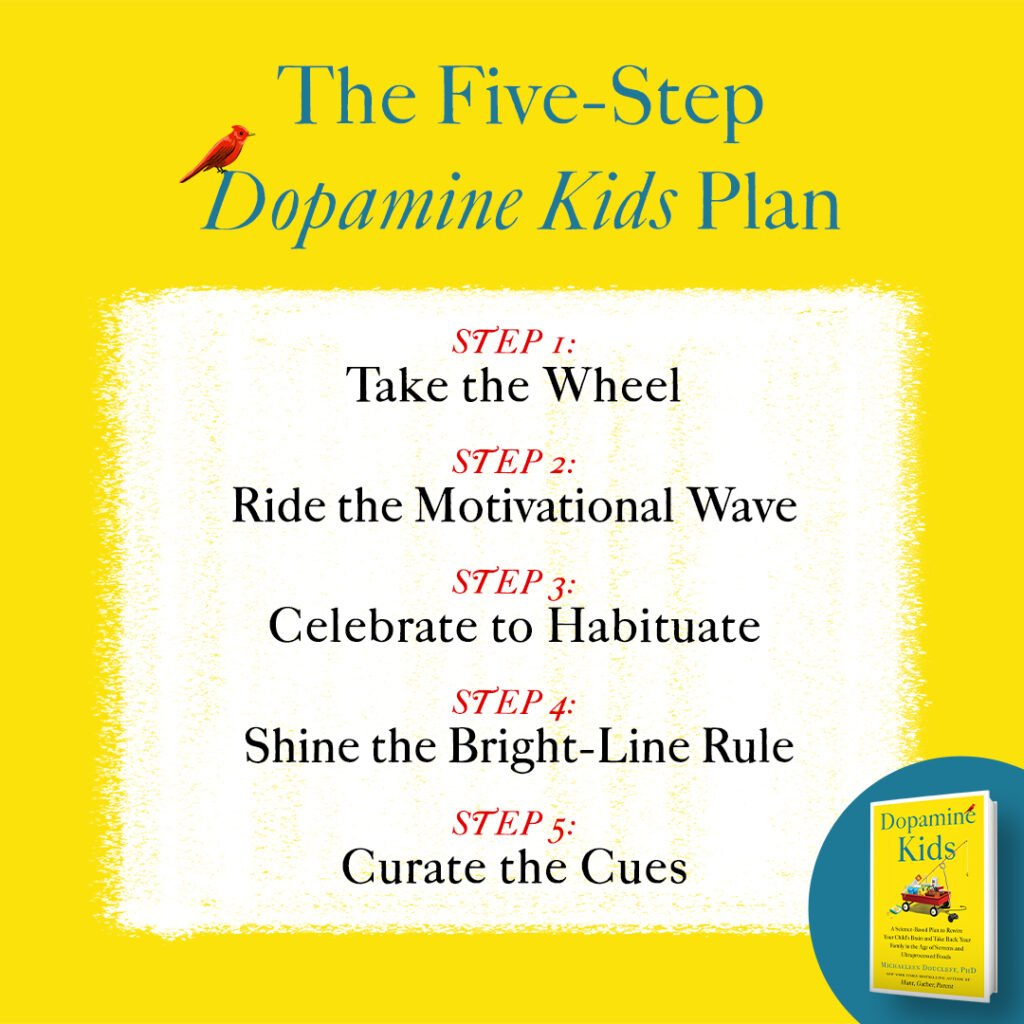
Author Michaeleen Doucleff offers a five-step process (based on science, not guessing) to redirect kids away from whatever it is that doesn’t serve them anymore, towards something more beneficial. Maybe you don’t want your child to watch YouTube, or eat Twinkies, or rot on social media. Maybe you wish your family rode bikes more often, or made dinner at home, or read books at bedtime. Whatever it is…Michaeleen has a way to redirect the old habits into new ones. I’ll explain how.
A Science-Based Plan to Rewire Your Child’s Brain and Take Back Your Family
In the book “Dopamine Kids,” Michaeleen helps us reduce screens by specifically explaining how she got her daughter off screens. Michaeleen incorrectly assumed, like many of us, that her daughter loved watching TV. Specifically, the Netflix show Lego Friends. Her daughter Rosie sat transfixed, staring at the laptop screen like a zombie…. until it was time to go to bed. At which point, (as we parents know too well) Rosie totally lost her $#@*.
Every night Michaeleen would watch Rosie run around the house, screaming, crying, hiding under the table- all because she was asked to turn off Lego Friends. And Michaeleen kept tolerating the behavior because she assumed that watching the show was Rosie’s favorite hobby. Until… she finally noticed, “In our home, I surely didn’t see more and more joy as Rosy spent more and more time on Netflix or Youtube. I saw the opposite. I saw more and more conflict, tears, and overall difficulties for our entire family. I observed a calm child turn into a tornado of yelling and anger, a cheerful child turn into a sad one.”
What was happening?
Michaeleen decided to investigate what was turning her sweet daughter into a Netflix-induced warewolf. And she soon learned that everything we know about dopamine is wrong.
Everything We Know About Dopamine is Wrong (until now)
For many years, the scientific community thought that dopamine was a brain chemical (or neurotransmitter) that caused humans to feel pleasure.
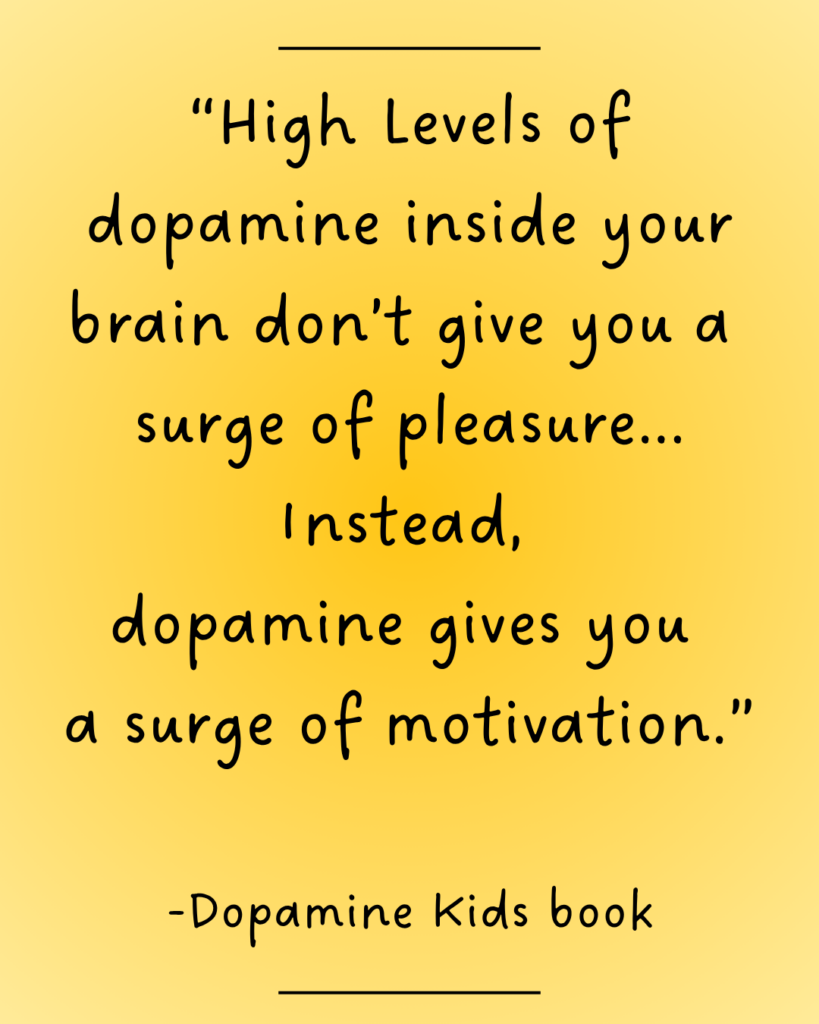
However, scientist Kent C. Berridge discovered around 1993 that dopamine in your brain does not give you a surge of pleasure. Instead, dopamine gives you a surge of motivation. Historically, we needed dopamine to motivate us to eat food, reproduce, and run from predators. But in the modern day world of convenience, our main source of our dopamine is ultra-processed food and technology.
When kids are watching their favorite show, or scrolling social media, or playing a video game – their brains are not saying “this is great.” Their brains are saying, “I need more.”
When you stop a child abruptly from their high-dopamine activity, whether it be a show or a video game, dopamine levels are still high. The problem is, that dopamine tells you that you need to mobilize. Author Michaeleen Doucleff explains, “It told Rosy to do it again! Watch again. Watch again. And it motivated Rosy to go get what she wanted, hell or high water. It told her to persist, work through challenges that arise, and accomplish this important goal of watching Lego Girls. To push through and find a way around any obstacles….. In other words, the extra dopamine in Rosy’s brain told her to find around this crazy middle-aged woman with a timer and a toothbrush who was thwarting her from reaching her goal. It told her to find a way around bedtime!” Rosy wasn’t experiencing great pleasure, she was experiencing massive motivation.
OMG.
This explains so much.
I finally understand why my sons sobbed after I pulled away the iPad. I understand why they tried to bite me when I turned off Minecraft. But I had never understood how to change the dynamic. Until now.
Enter the 5-step process in “Dopamine Kids.”
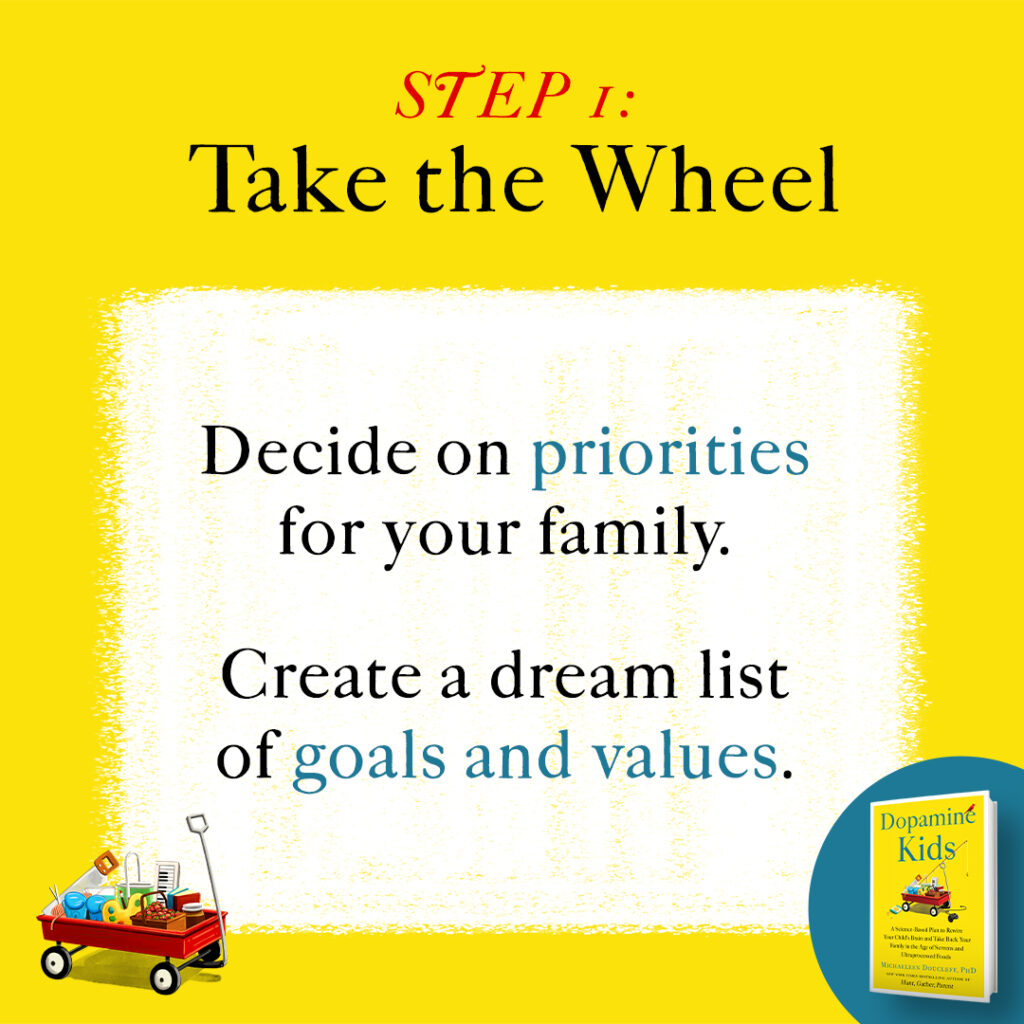
Dopamine Kids Plan Step 1: Take The Wheel
Reducing or eliminating addictive technology in your child’s life won’t deprive them of a favorite hobby. Instead, it will protect them from the upsetting and dysregulating feelings caused by the technology. As Michaeleen writes in Dopamine Kids, “If Lego Girls wasn’t Rosy’s favorite hobby, then what could be?”
This is your chance as a parent to take the wheel. If your child isn’t watching cartoons every night after dinner, or scrolling their phone in the car, or gaming all day every weekend- then what do you want them to do instead?
Identify Alternative Activities to Replace the Unwanted Ones
Author Michaeleen Doucleff encourages us to make a dream list of goals and aspirations for our family.
Page 32 is a chart that you can cut out of the book and use to determine your values and goals, and what specific behaviors support that goal.
Do you want your kids to love reading? You could create a cozy corner in their bedroom where you read together at bedtime. Do you want your kids to value exercise? You could ride bikes to school as a family. Be specific about the activity as well as the time of day when that activity will happen. You decide what is important to you, and impart those values to your children through your actions and habits. If you don’t value idle screen time, remove it from your regular routine.
For Michaeleen, she really wanted her daughter to love playing outside. She writes, “I decided that I want Rosy to play outside after dinner and on Saturdays.”
Many of us remember fondly the freedom and fun of riding bikes outside with friends until the streetlights came on. Like us, Michaeleen wanted her daughter to enjoy being outside with friends, and needed to find a way to harness her daughter’s motivations to engage in this activity. Thus, it was time to ride the motivational wave…
Dopamine Kids Plan Step 2: Ride The Motivational Wave
When you are identifying an alternative activity to replace the unwanted one, make it easier on yourself and harness the motivation your child already has. Offer an equally alluring activity. In other words, if you’re taking away your son’s video game, you had better replace it with something you know he’s already highly motivated to do.
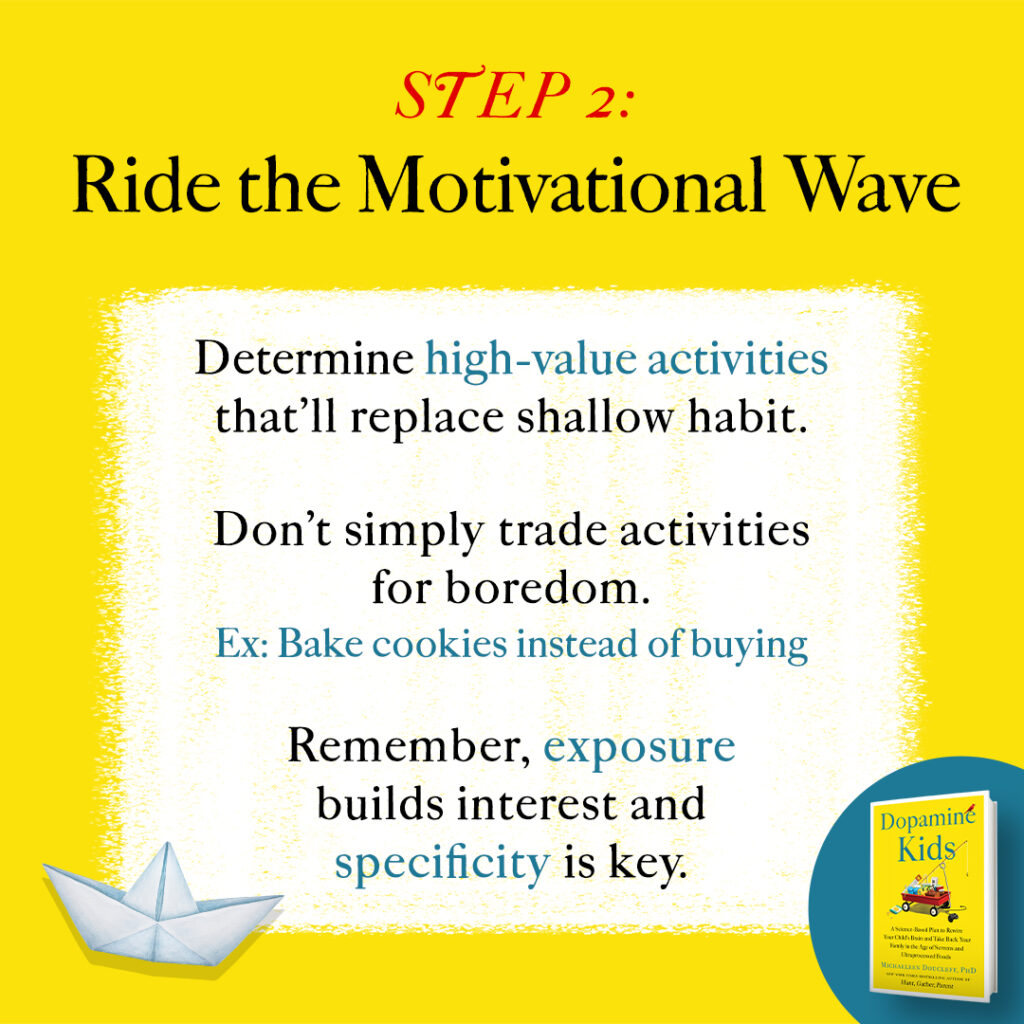
Dopamine Kids argues that a good replacement will contain three characteristics:
- The child wants it.
- The parent wants it.
- It’s sustainable.
Ask yourself, and then ask your child, what’s something they have been wanting to do? It may be something a little “risky” that you haven’t yet allowed. Do they want to use the oven to bake cookies? Walk alone to grandma’s house? Use Dad’s “real tools” in the garage? Figure out a way to funnel that motivation towards the valued activity you want to instill in their life.
Remember to keep their interests in mind. I used this strategy to increase my sons’ interest in reading. I knew that they were obsessed with Minecraft, but I didn’t want them playing video games any more. Thus, I found books and magazines at the library that were all about Minecraft. They were thrilled to read these books because they were about a beloved topic. Similarly, when they started begging to play Minecraft and I didn’t want them to partake- I directed them towards creating hands-on Lego scenes of what they would have made inside the video game. Score!
As a side note, if a child hasn’t been exposed to activities that don’t involve a screen, they don’t have motivation for these activities. You can’t comprehend how much fun it is to water ski, or play piano, or read a novel if you’ve never done it. In other words, “If a child says they’re ‘bored’ without a screen, then they haven’t learned yet how to love and crave activities off the screen.'”
Michaeleen wanted her daughter Rosy to value playing outside, as Michaeleen had done as a child. She also knew that her daughter was yearning to do something independently without parental involvement. Thus, Michaeleen combined her values with Rosy’s desires, and decided to steer Rosy towards a nightly bike ride to the neighborhood market.
Instead of watching Lego Girls every night after dinner, Michaeleen redirected her daughter towards outdoor play.
But take note! This transition didn’t take hold in just one night. It took a few more specific science-backed steps to rewire Rosy’s brain from desiring Netflix to desiring an evening bike ride. Which takes us to step 3:
Dopamine Kids Plan Step 3: Celebrate To Habituate
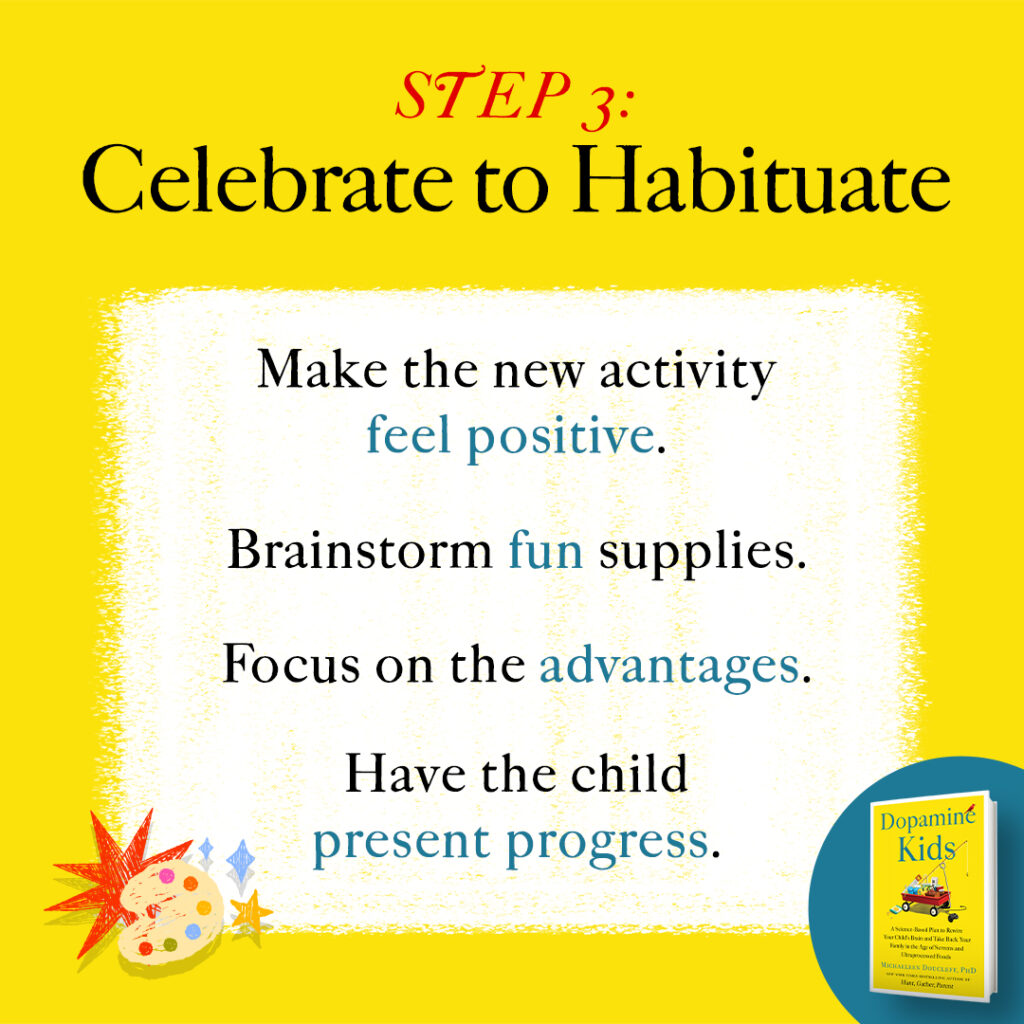
Celebrate the New Activity
The third step in redirecting a child from an undesirable activity to a worthwhile one, is celebrating the new activity.

Before presenting a new activity, you may want to invest a small amount of time or money into preparing for it. In order to create a desirable place to read in my son’s room, I bought a big comfie chair, and surrounded it with shelves of new and old books. I also bought a scratch-off poster of “100 Best Books For Kids,” so that we could keep track of our reading progress.
When Michaeleen was preparing to introduce the nightly bike ride to her daughter Rosy, she got her bike tuned-up and made a special place on the front porch for easy bike access. This makes the new activity attractive, and signals to your child that it is a valued pastime.
Present the New Activity Positively
Part of the celebration is the hype. Prior to making the switch, be sure to speak of the new activity in a good light. If you’re transitioning your child from watching television to learning how to juggle, don’t say things like, “I know that turning off the TV is going to be hard and you won’t like it.” This emphasizes what the child will be losing and makes the new activity feel like a punishment or a second-rate alternative. Instead, mention the detriments of the old habit and the benefits of the new. For example, “I’m so excited to learn a new skill with you. This will be something fun to show your friends. Instead of loosing time on TV, we will actually have something to show for our time after this afternoon.”
Michaeleen explains that before she transitioned Rosy from watching Lego Girls to bike riding, she often mused aloud about how biking can be an “adventure,” and a “chance for freedom.” She writes, “One day I told her, ‘Once you learn to bike around town alone, you’re a free woman.'”
Celebrate Your Child’s Work
Children love to share their accomplishments with other people, especially their family. If you allow your child to present new skills or creations it offers a huge emotional payoff, and is essential to forming a new habit.
If your child’s new habit is drawing pictures of animals, let them do an art show for the family. If their new habit is reading, let them explain their favorite part of their book or make a presentation about the characters. At our house, we created our own board game based on the books we had read, and the kids loved that they knew all the answers to the book-based trivia (and that Dad didn’t!)
Michaeleen emphasizes in Dopamine Kids to “point out how good the new hobby makes everyone feel afterward. You don’t have to say much. Something simple works well, such as ‘I always feel so good after drawing.'” Over time, “you’re also teaching the child to pay attention to how activities and foods shift their moods and alter their emotions.”
Dopamine Kids Plan Step 4: Shine The Bright-Line Rule
In the legal profession, “bright-line rules are ones that are so clear and simple, they leave no room for debate or discussion. For example: People under twenty-one can’t drink alcohol legally…… You either broke the rule or not. There’s no wiggle room.” Dopamine Kids explains that bright-line rules can be very helpful in instilling new habits because they don’t allow for people to make exceptions and return to an unwanted habit.
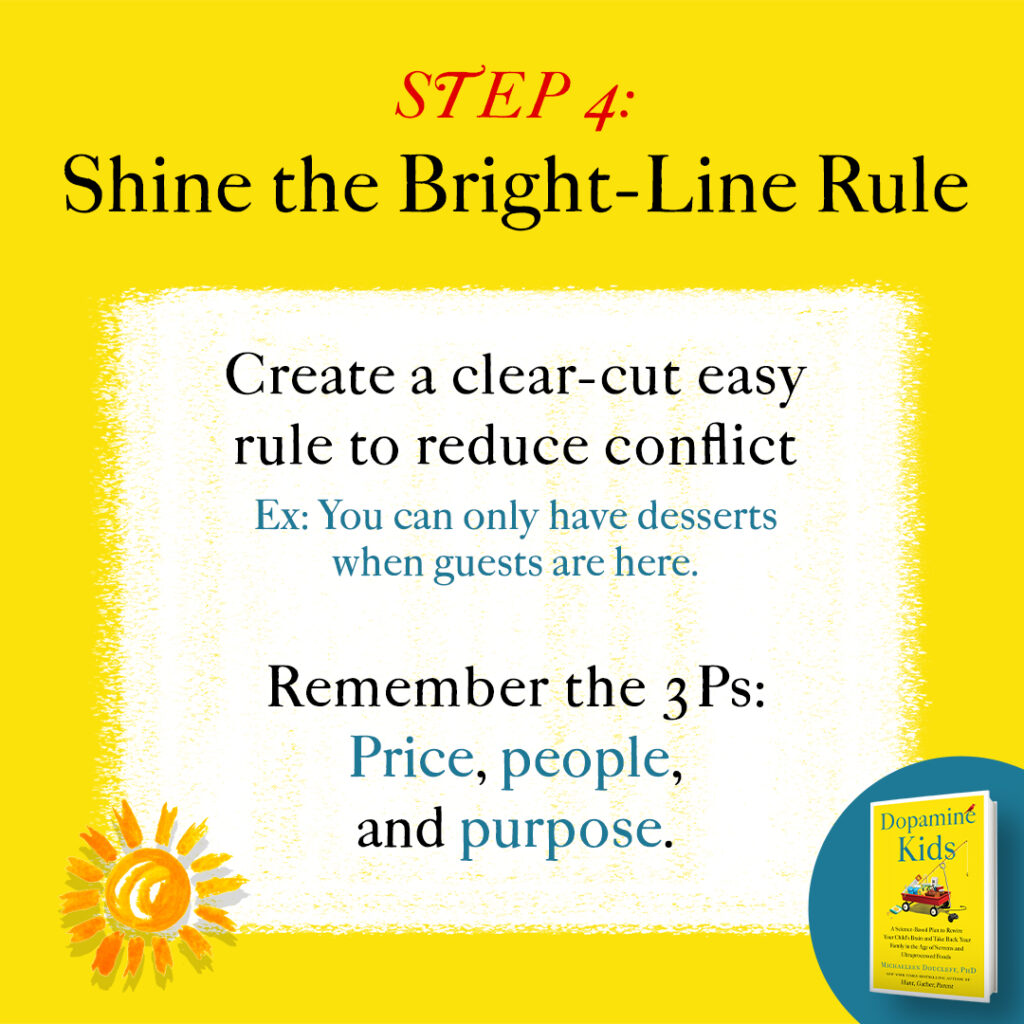
In our house we have a bright-line rule that we don’t use screens on Sundays from the time we wake up until 5:00pm. We also have a bright-line rule that my kids can’t play Roblox ever. When Michaeleen was trying to transition her daughter Rosy from watching Lego Girls after dinner to riding bikes after dinner, she instated a bright-line rule: “Our family doesn’t use screens after dinner. Never again.“
However, and this is a big one– Michaeleen didn’t tell Rosy about the bright-line rule until a few weeks into the transition. She knew that announcing the rule while introducing biking would only create conflict and chaos. She admits, “I kept the bright-line rule to myself for a while. But I created one for myself so that I could stay firm when she begged or tried to change my mind about Lego Girls. The bright-line rule helped me value and stick to our new goal as a family.” She and her husband decided that the rule would apply to them as well, and stopped using phones or laptops for entertainment purposes after dinner.
Dopamine Kids Plan Step 5: Curate the Cues
Experts advise that the best way to stop an unwanted behavior is to remove the cue. However, if you are consistently pulled toward a “motivational magnet” like screens (or Trader Joe’s cookies) you can’t just hide them in a drawer (or the front seat of your car.) For adults, the cues need to completely disappear from your home. (i.e the Instagram App or the cookies.) If you know that the app is still on your phone, you won’t have the willpower to avoid it. If you buy the cookies, they will eventually get eaten… (possibly late at night….probably after your children have a huge meltdown.)
In the case of children, they need to think that the magnet is inaccessable. As Michaeleen puts it, “If the child believes there’s even an iota of a chance to go online or have one Cheez-It, their dopamine circuitry will light up like the Las Vegas skyline…. They’ll feel a strong, visceral craving for the activity or food, and they’ll work hard to obtain it.”
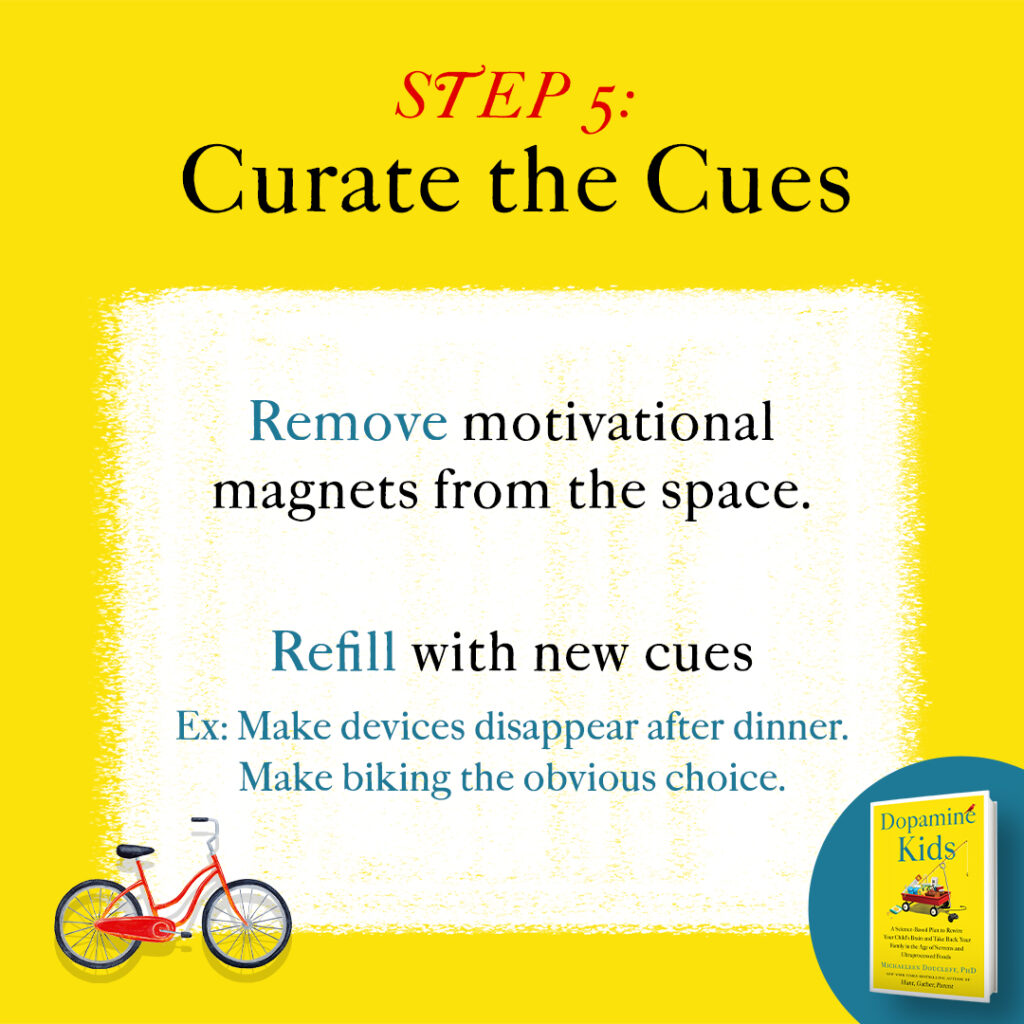
Conversely, and critically, “if a child knows the device or ultra-processed food isn’t available in a particular context, the motivation circuitry relaxes….. The child can focus their attention and desires on more fulfilling activities.”
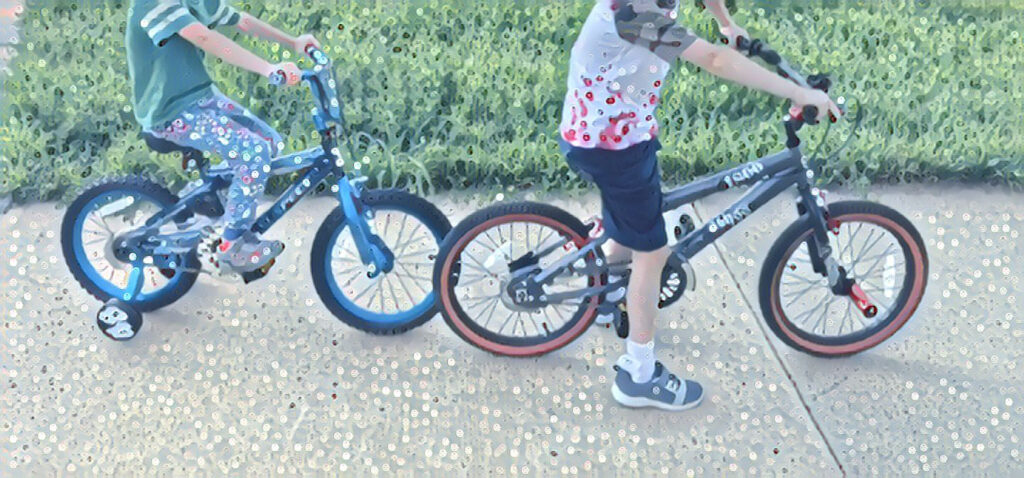
Michaeleen identified that the cues pulling Rosy toward Netflix after dinner were seeing Michaeleen’s phone and laptop (where the show had always been viewed.) To avoid these cues setting-off Rosy’s dopamine cycle of wanting, Michaeleen wrapped her laptop and phone in a blanket and hid them in the dryer. Then, she made the cues for biking obvious and enticing by putting their bicycles on the front porch. “I had to make it so easy for Rosy to hop on her bike that she didn’t have time to whine, complain, or think about Lego Girls.“
Putting It All Together – You Can Do This!
Michaeleen Doucleff’s transition of her daughter from watching screens to riding bikes is a master class in parenting. Throughout Dopamine Kids, Michaeleen explains the five steps that led her to the big night; the night when she would attempt to get Rosie to stop watching Lego Girls and start riding her bike to the neighborhood market.
I thoroughly appreciate that Michaeleen explained exactly how it went down. We all need a mentor in this tough parenting world!
She writes, “After dinner, as I was scraping the leftover chicken and rice into the dog bowl, Rosy came over and began making her case for cartoons.”… “I responded with a positive but tempered tone: ‘Oh my gosh, Rosy, tonight I have a wonderful surprise for you. Something that just may be better than watching cartoons…if you’re up for it.”
Rosy’s curiosity was piqued!
Michaeleen suggested that they clean up the kitchen briefly and then she would find out. (Curiosity is a huge motivator. By Michaeleen setting-it up as a mystery, Rosy was super motivated to find out what the activity was.)
She continues, “After we finished cleaning, I said to her, ‘Ok. Let’s go outside for the surprise. It’s going to be a fun adventure.” (Notice that she is celebrating the new activity, and NOT mentioning the old one.)
Michaeleen recounts that they left behind all the cues in the living room that would draw Rosy to screentime, and went onto the front porch. She told Rosy, “‘Tonight I’m going to teach you to ride to the market so you can start doing it alone. Can you believe it? All by yourself. It’s going to be scary…but fun.’ (Challenges motivate children, as does fun!) She recounts, “My bike celebration distracted Rosy from the thought of Lego Girls long enough to walk outside (and into a fresh context.)” While they were riding Michaeleen tossed out a few tiny celebrations like “this is fun” and “I love riding.” And she admits that it did feel good. She saw the same happiness when she looked over at Rosy.
After they biked to the market and returned home, Michaeleen thanked Rosy for going, and pointed out how good it felt to ride through the fresh air, enjoy the outdoors, and connect with her daughter in a new way.
Now of course, Rosy didn’t immediately forget about Lego Girls. She asked for it many times in the days ahead. But, when Rosy asked for the show, Michaeleen intentionally brushed it off quickly. “The bigger deal that I made of Lego Girls, the bigger deal Rosy would make of it…Children decide what’s important by looking at how [parents] act.”
She also intentionally did not tell Rosy that this new routine was permanent. She just threw out phrases like, “It’s a good time to take a break from Netflix.” She continued to focus on the advantages of biking, and the disadvantages of Netflix. When Rosy asked about Lego Girls, Michaeleen reminded herself of their bright-line rule: our family doesn’t use screens after dinner. After about six months, Michaeleen decided to share the bright-line rule with Rosy. She explained, “We’re a family that doesn’t need screens to have fun.”
Michaeleen eventually started to really savor time without devices. It took a few months (this isn’t an instant fix) but she felt liberated from the constant modern feeling of “what’s next?”
Then, one day, Rosy surprised the heck out of her mom Michaeleen…
“She started to do the holy Grail of modern parenting: She went and played outside, voluntarily, for hours, on her own or with friends.“
One Saturday afternoon, Rosy and a friend spent six hours outside, climbing trees and riding bikes. Michaeleen gushes, “I could see that those biking escapades gave the girls two things that Lego Girls or YouTube never could: joie de vivre and a bone-deep tiredness.”
I have found this to be very true in my own life. When I first started “Screen Free Sunday,” my boys whined and moaned for television about five times per minute. But by week three, they didn’t even ask. Not once. Now after almost five years of abstaining from screens on Sundays, my boys wake up, and begin playing something analog immediately. Sometimes they play chess, sometimes they build a fort, sometimes they wrestle around for a while and then read books. I had created a bright-line rule and didn’t even know it. And it works.
I’m not implying that you won’t have to endure a little whining now and then. This method isn’t magic. However, if you use the five steps outlined in Dopamine Kids instead of just yanking away a bad habit cold turkey, you won’t have to deal with the massive blow-ups and inconsolable meltdowns. You can change a habit gradually and successfully.
Dopamine Kids is Dope
Sorry for the awful pun…I couldn’t resist. But seriously, this book is amazing. There is SO much other fascinating advice that I didn’t even touch in this essay. Author Michaeleen Doucleff explains how both modern technology and foods have been designed to hook us, and the history of these unhealthy industries. As the subtitle promises, this book really is “a science-based plan to rewire your child’s brain and take back your family in the age of screens and ultra processed foods.”
The book explains seven fundamental needs of all children, how modern life isn’t satisfying them, and what we can do as parents to make sure they are fulfilled. And, best of all, the book lays out a four-week transformation which offers step-by-step actions to revamp your family’s relationship with activities on screens and bring more pleasure back into your life. She explains how to create sanctuaries for conversation, focus, sleep, and adventure.
Please tune in to the Screen Less Play More podcast for my amazing conversation with Michaeleen Doucleff, author extraordinare! You can also find resources pertaining to Dopamine Kids at Michaeleen’s website.
If you have never read Michaeleen’s other incredible parenting book “Hunt, Gather, Parent,” you can hear a quick recap of the book here.
Thanks for reading “Dopamine Kids” Book Has The Formula to Get Kids Off Screens Without A Fight!

Hear Michaeleen Doucleff Explain Why Everything We Know About Dopamine Is Wrong
I am an affiliate of Amazon, so if you buy something through a link I will get a small commission at no cost to you. Yay!