It’s not your imagination, kids are addicted to screens. But it’s not their fault! (Or the fault of their parents.)
Dr. Richard Freed, child and adolescent psychologist, explains how Silicon Valley’s secret science of persuasive design is stealing childhood. But he advises us, “parents should not feel, like ‘what have I missed?’ This has purposefully been hidden.”
Dr. Freed tells the Screen Less Play More Podcast, “We need to help families understand that there is a science behind this.” He explains that many of today’s app makers from Facebook and Instagram, took a class at Stanford in the 1990s, now colloquially referred to as “The Facebook Class.” Taught by behavior scientist B.J. Fogg, the class taught students how to create “machines designed to change humans.” Fogg taught students a simple equation, that in order to get the desired behavior from users, you must simultaneously engage three factors: motivation, ability, and triggers.
Listen to the episode here:
Big Tech’s Formula of Addiction
Big tech combines motivation, ability, and triggers to get kids addicted to their screens. Kids are motivated to go on social media and video games because they offer psychological rewards such as entertainment, humor, and a sense of belonging. They may be motivated to return to sites like Snapchat due to incentives such as “Snapstreak.” The Snapstreak feature indicates how many consecutive days two users have been sending each other photo or video Snaps, and rewards them for not breaking their streak.
The “ability” part of the equation is essentially how easy the apps are. Dr. Freed explains, “You can roll over on your bed and maybe consume half a calorie, and click buttons for hours on end.” The “trigger” part of the equation could be an email from Facebook that says you haven’t logged in for a while, it could be a notification “ping” that you have a new “like,” or it could be something within a video game triggering you to continue playing. Freed says that persuasively designed technology is “always triggering you to go access those easy rewards.” He warns that “Silicon Valley wants to trigger you until you develop an internal trigger.”
Once people develop an internal trigger, they may find themselves at a stop light or waiting their turn in line, and feel compelled to check their social media accounts. At that point, kids and adults are truly addicted to screens. Dr. Freed says it’s like the cigarette smoker that smokes after dinner. “Why did I light up after a meal? I don’t know, I just did it….These are impulses that we don’t even know why we’re doing them. Ask a kid why they’re living their lives on a video game, a phone, or social media, and they’ll say ‘I don’t know.'”

Social media is a slot machine
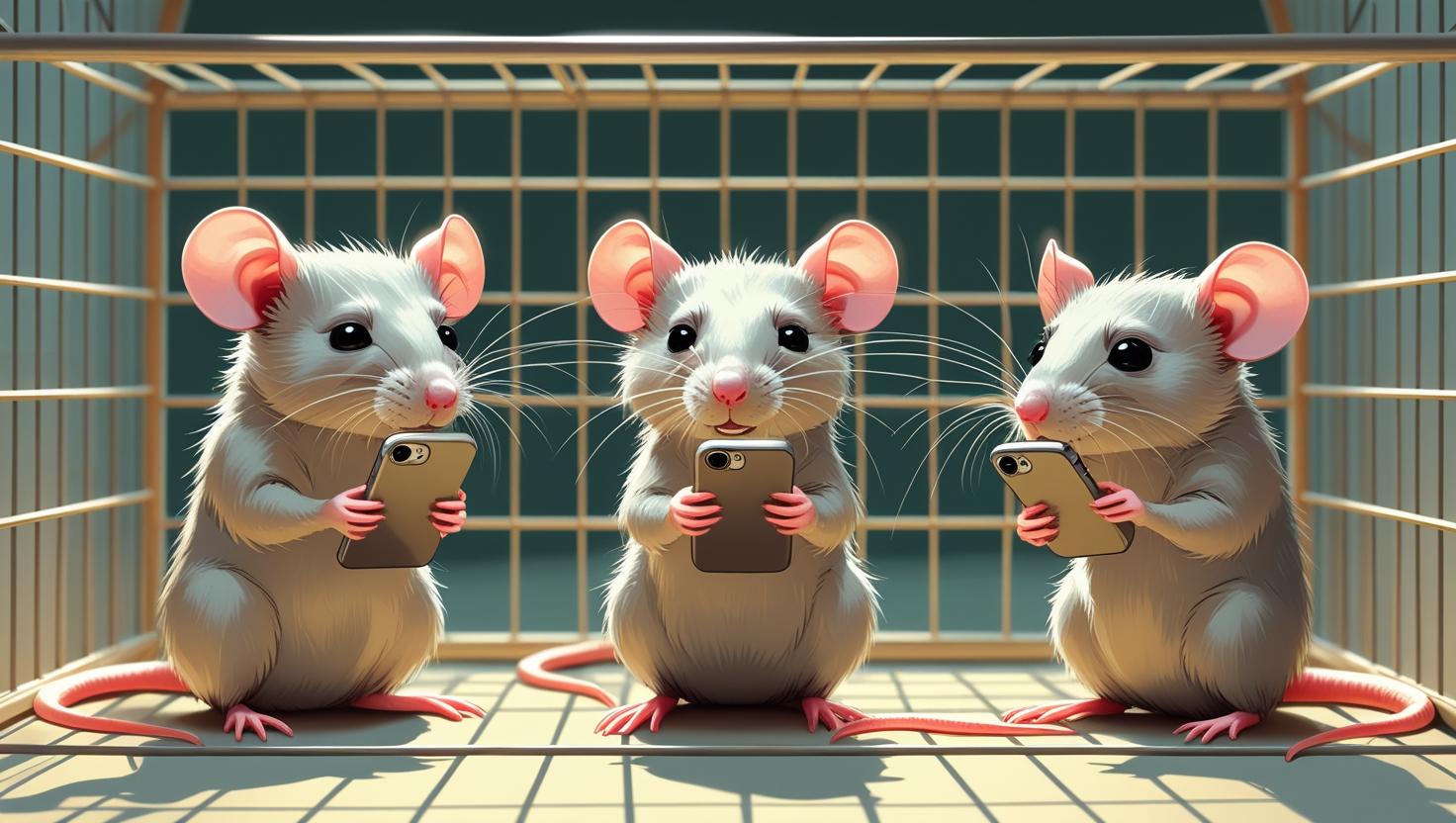
Social media addicts people through the same mechanism as a slot machine. This concept was conceived by psychologist B.F. Skinner in the 1950s. He figured out that if you put a rat into a box and offer it food intermittently when it presses a lever, it will continue to press the lever forever. The food may come after one press, or after 100 presses, so the rat continues to press. Humans will do the exact same thing to achieve a reward on a slot machine, a social media feed, or a video game.
The intermittent nature of the reward is what makes the system work so well. This is why kids are addicted to screens. Dr. Freed tells Screen Less Play More Podcast that sporadic reinforcement is the “key element of motivation. We’re going to put that on a slot machine schedule because the mammalian brain wants order. We need to figure out something and if it’s truly random, we will go at it and go at it and go at it, and people will lose their lives to a slot machine. They’ll lose their house, and their wife, and their life because the human brain can never figure that out. If you just rewarded people every fifth time they pulled a lever, the human brain would walk away from that in about an hour…But if you put it on a truly random reward schedule, people will go at that.”
Dr. Freed explains that the lever for the rat to press has been replaced in modern life by a notification on your phone. “Ping, go over there and check your digital reward. Who’s liked your photo?”
Why are kids addicted to Fortnite?
Dr. Freed explains to our podcast that video games are designed to addict by targeting the primal wiring of humans, especially boys. The most effective games of this sort are Fortnite, Call of Duty, Minecraft, and World of Warcraft.
“This little modern world that we live in is completely different from the four million years that we lived essentially all in the same environment, all across the world. And that is, to be a boy, you needed to do two things…And that is: to hunt or fight, and to build shelter,” says Dr. Freed. “What are the two things in Fortnite that you essentially gain points for? Hunt, fight, and build shelter.”
“That is not a game. That is a machine that is designed to target your kid’s DNA to go down to their soul,” warns Freed.
Dr. Freed says, “So you have a generation of boys growing into young men, feeling like they’re sometimes happy…. ‘I haven’t got a job. I kinda didn’t do very well in school or I failed out. I’m living in my parents’ house. I have no prospects of kind of moving forward, but I sure feel like I’m competent. I sure feel like I’m with my tribe of boys to young men to whatever. Like, wow, look at what we’re succeeding.’ Some boys wake up to go, ‘God, what have I done?’ Some boys just don’t.”
How to stop kids from getting addicted to screens
Kids (and many adults) are addicted to screens. So what do we do now? Should we throw out the Playstation? Drop the iPhone in the garbage disposal? Take a sledgehammer to the television? Well…
Not all screens are equal.
Dr. Freed explains that there is a big difference between watching a television show or a movie, and scrolling on TikTok. “A movie that has a screenplay, that’s art. It does not have an experimental science in it, and thousands of AI experts, and neuroscience experts behind it…. behind the screen that are oftentimes monitoring kids in real time, and making adjustments in real time, to perfectly tune that instrument to pull that kid on the game and keep them there.”
So if you really need a moment to yourself, don’t hand the kids an online game or Facebook. Stick to the kinds of entertainment that are not engineered by Silicon Valley scientists: movies, television shows, audio books, podcasts. If your child wants to play a computer game, stick to a virtual version of a real game like chess or solitaire. And yes, there are Playstation games that aren’t engineered to addict, but they are few and far between. Something like “Farming Simulator,” or “Power Wash Simulator.” Yes, those are real, and my kids actually play them occasionally. They look insanely boring to me…. but that’s exactly the point.
But the Academy of Pediatrics says it’s ok…
Dr. Freed reveals that the associations that parents once trusted, are riddled with conflicts of interest. Freed researched The American Academy of Pediatrics, the American Psychological Association, and Common Sense Media. He tells our podcast, “You should not have child dietary guidelines funded by McDonald’s and Coca-Cola. That would be laughable, ludicrous, we know it would be dangerous. That’s exactly what’s happening with medical organizations.”
“The American Psychological Association, they have a dual relationship. They are a professional organization trying to place psychologists at Facebook, Instagram. They are trying to and sort of profit off of that as an industry. That’s what a professional organization does. They can then not be also a quote unquote health organization that then supposedly judge kids’ health-based effects of being on that social media because they can’t literally speak the truth.”
Dr. Freed warns, “The American Academy of Pediatrics is worse than the APA. Their chief ‘expert’ about kids and screens and social media is is Dr. Moreno who’s received funding from Facebook Instagram. You literally cannot do that. That’s laughable. It’s tragic. It’s dangerous.”
He continues, “And then there’s these groups that are what I call the ‘Silicon Valley propaganda machine’ like Common Sense Media. And I’m sorry if your listeners, a lot of them have probably been told that Common Sense Media is where you go find the truth. And it used to be they were truthful and they have done some good, but around 2012 they shifted. They’ve taken millions from Zuckerberg.”
Learn more about the science addicting kids to screens!
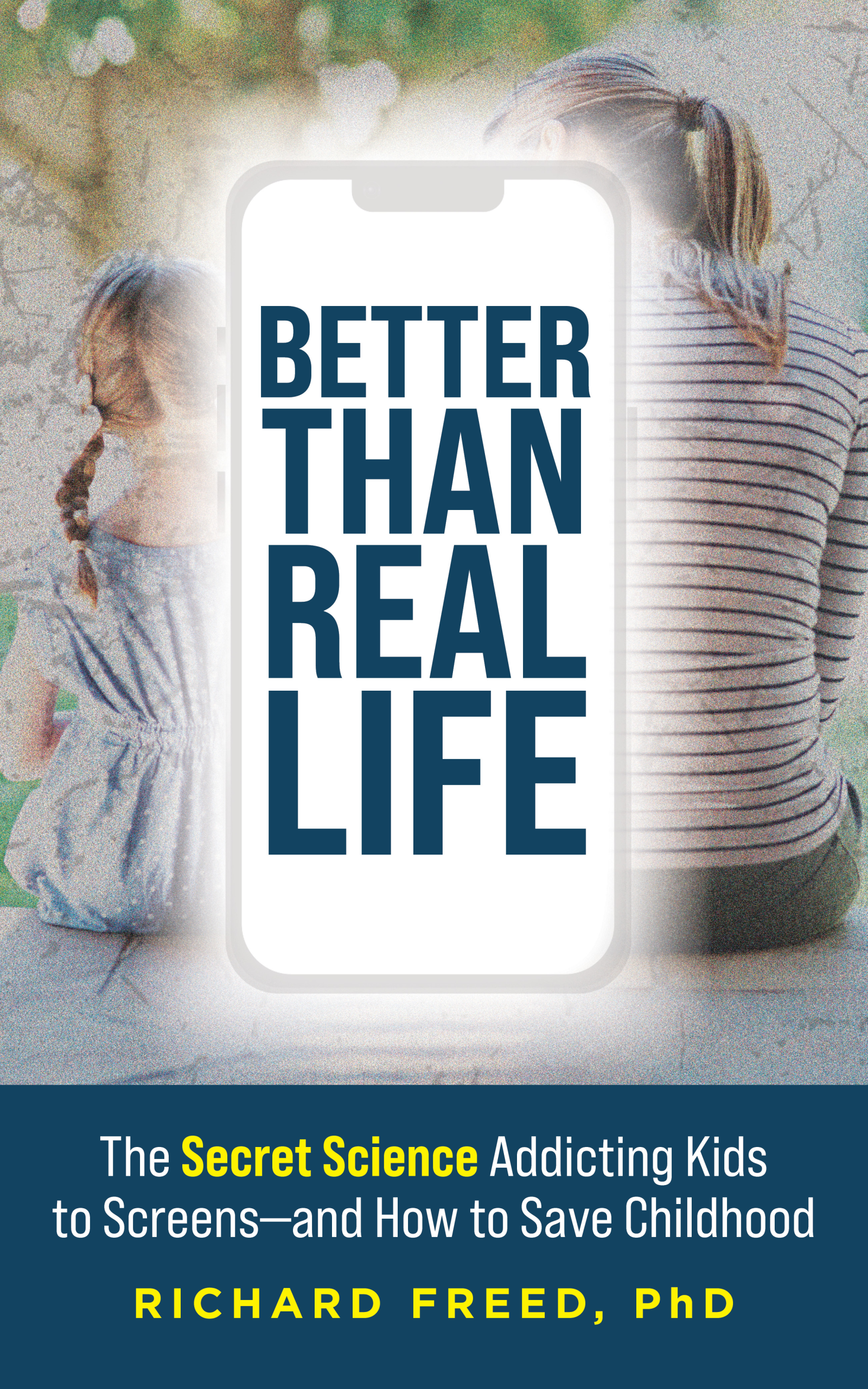
There is so much more amazing, mind-blowing information in Dr. Richard Freed’s interview with Screen Less Play More, as well as his fascinating book! The title is “Better Than Real Life: The Secret Science Addicting Kids To Screens – and How To Save Childhood.” The previous title was “Better Than Real Life: How Silicon Valley’s Secret Science of Persuasive Design Is Stealing Childhood.”
You can also learn more at Dr. Freed’s website www.richardfreed.com
For Bonus Content, checkout My Substack!
Is social media safe for kids?
Nope!
Social media is one of the most addictive forms of entertainment for anyone, especially children. Former Snapchat executive Sarah Gallagher Trombley spoke to the Screen Less Play More podcast and gave us some amazing insight on parental controls, best practices, and text group chats. She explains the hidden dangers of Snapchat, Roblox, and many other social media traps. For more info read our post and check out her podcast episode here:
My kids are addicted to screens! Help!
What if your kids are already hooked?
Our episode with Michael McLeod of GrowNow ADHD was amazing! He gives many tips and tricks to untangle kids from screens. He also give some no-nonsense parenting advice about how to develop executive functioning skills, and have a fulfilling childhood!
More resources on kids and screens
Disclosure: I am an affiliate of Bookshop.org and I will earn a commission if you click through and make a purchase
Online safety training for tweens and teens- sign up now!
Try Screen Free Sunday! It’s easier than you think. Here’s how to start.
Play these outdoor games instead of doing screens!
Going on a road trip, or want to keep kids busy without screens? Here’s your shopping list!
The dangerous hashtags that put kids at risk.