“Dopamine Kids?” Did I hear you right? The author of my favorite parenting book “Hunt, Gather, Parent” has a new book – and it’s about screen time and kids? YES, PLEASE!
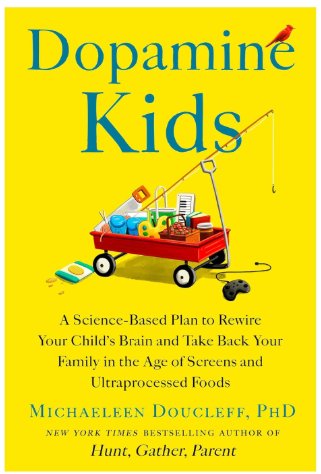
The upcoming book by Michaleen Doucleff is titled “Dopamine Kids: A Science-Based Plan to Rewire Your Child’s Brain and Take Back Your Family in the Age of Screens and Ultraprocessed Foods.“
“When Michaeleen Doucleff, PhD, the New York Times bestselling author of Hunt, Gather, Parent, decided to address her family’s screen time and dependence on processed foods, she found that scientific study after scientific study refuted nearly all the claims she’d read in the media about dopamine and the supposed reasons we’re so inclined to pick up our phones or raid the pantry,” per the publisher.
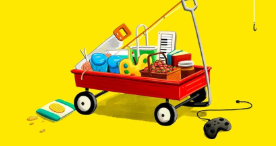
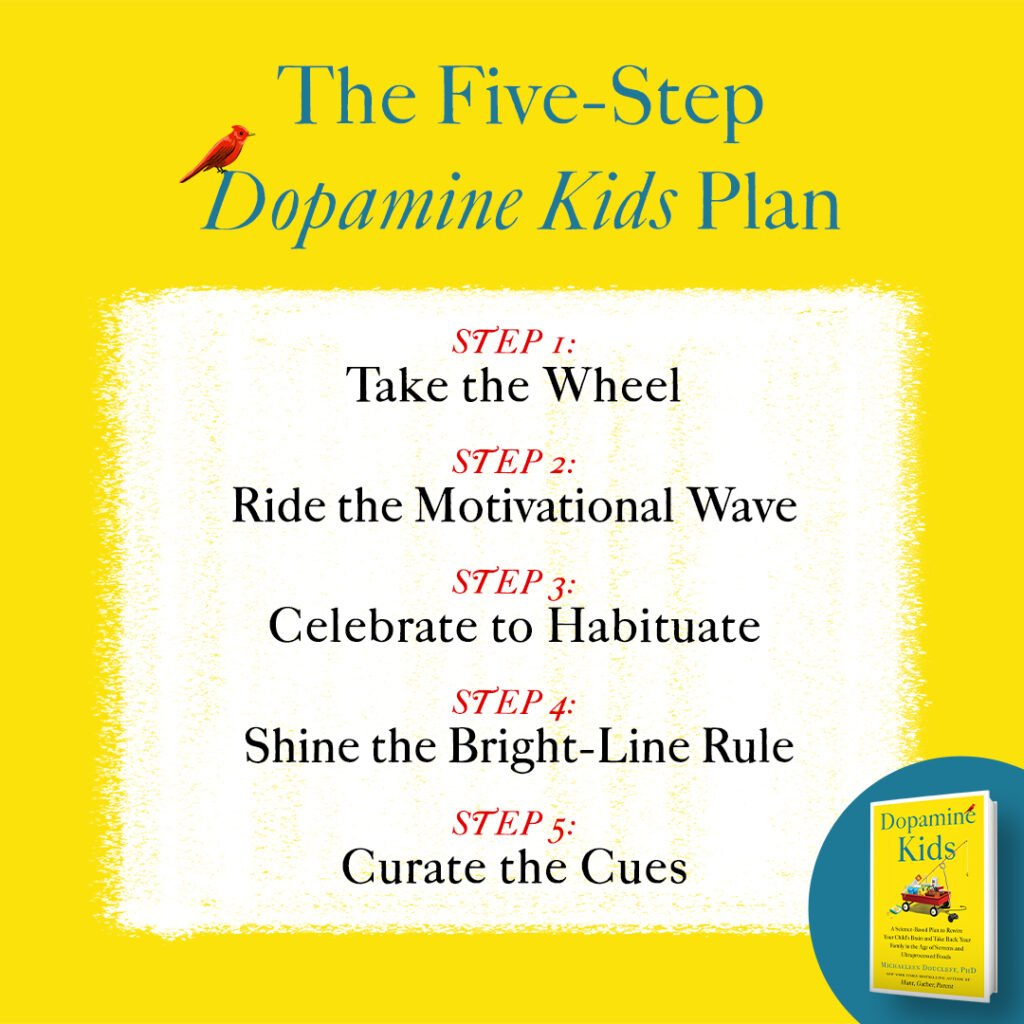
“Dopamine Kids is a five-step operating manual for habit remodeling that is tailored for parents and their children. After rediscovering what’s most important for your family, you’ll learn how to create successful boundaries around screens and ultraprocessed foods; replace screen time with equally enticing activities; remove triggers that pull children toward screens and junk food; and, finally, celebrate your family’s choices before, during, and after trying new hobbies. These five steps weaken the neurological pathways established by devices and make dopamine work in your favor to get kids to want to pursue high-quality activities that reduce anxiety, create better moods, and diversify interests.”
When does “Dopamine Kids” come out?
Tuesday, March 3, 2026 is the release date for “Dopamine Kids” by Michaleen Doucleff. So, I guess I won’t be getting it from Santa after all. In that case, is the Easter Bunny listening?
Where can I buy “Dopamine Kids” book?
I personally have pre-ordered mine on Bookshop.org because I like to support local, ma & pa bookshops (but I also like to be able to order through the internet, since shopping with 2 children is like the 9th level of hell.) I am an affiliate of Bookshop.org, so if you order through my link, I will get a commission. Win, win! You can also pre-order through the usuals like Amazon.com, Barnes & Noble, and Walmart.
What is “Dopamine Kids” about?
“Nearly everything you’ve heard about dopamine is wrong. No, it’s not the molecule of happiness. And no, it doesn’t give us pleasure—it gives us motivation,” says Simon & Schuster. “For the first time in history, we are inundated with what are known as “dopamine surges” inside our brains. These surges pull us to technology like magnets, every day, many times a day. Over the past decade, neuroscientists have finally begun to figure out how these surges alter our choices, our habits, and even our moods. We’ve learned how dopamine can drive adults and kids to engage in activities that we don’t actually enjoy—activities that can make us feel sad, lonely, anxious, and depressed.”
Michaeleen explains the Dopamine system to the Screen Less Play More podcast here:
“Dr. Doucleff’s research culminates in a four-week plan to create screen-free sanctuaries that protect conversations, focus, sleep, and adventure. After reading Dopamine Kids, you will be empowered to create habits that genuinely fulfill your family’s biological and emotional needs, bring true fulfillment and purpose to their lives, and improve their behavior, happiness, and confidence. The Anxious Generation alerted you to the danger of screens, but the demands of the twenty-first century require that you use them anyway. Dopamine Kids is your handbook for solving that fundamental problem of our times—and teaching your kids to have a healthy relationship with technology and food.”
“For the first time in history, we are inundated with what are known as “dopamine surges” inside our brains. These surges pull us to technology like magnets, every day, many times a day. Over the past decade, neuroscientists have finally begun to figure out how these surges alter our choices, our habits, and even our moods. We’ve learned how dopamine can drive adults and kids to engage in activities that we don’t actually enjoy—activities that can make us feel sad, lonely, anxious, and depressed,” per the press release.
Read my review of Dopamine Kids here: (spoiler alert, I LOVE it.)
Hear Michaeleen, author of Dopamine Kids, discuss “F@*& – around and find out” parenting
She offers 3 EASY and important parenting tips
Who is the author of Dopamine Kids, Michaeleen Doucleff?
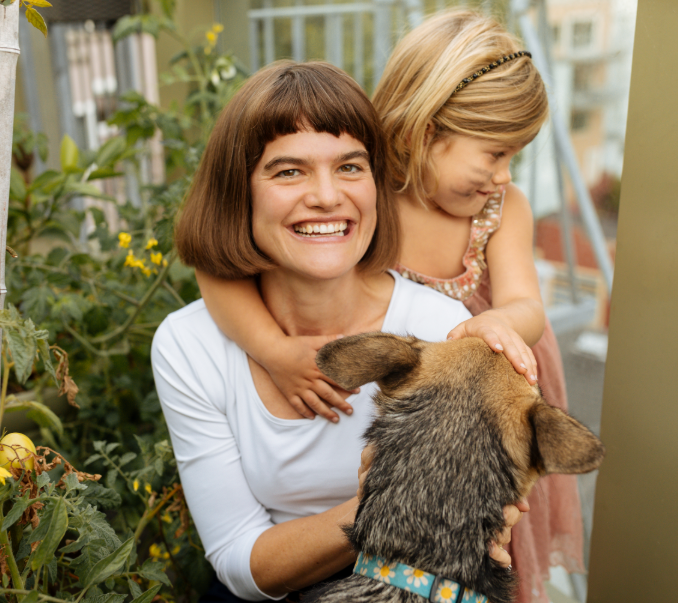
“In 2015, Michaeleen started her most challenging career: being a mom. This job began on shaky ground. She struggled, immensely, and felt like she was a terrible mom. Then, while reporting for NPR, she learned an ancient way of raising children that’s based on cooperativity instead of control and confidence instead of fear,” according to her website. “Now being a mom is her favorite career and helps her be a better writer and journalist. (You can learn this way of parenting, too.)”
“Michaeleen Doucleff is a correspondent for NPR’s Science Desk. In 2015, she was part of the team that earned a George Foster Peabody award for its coverage of the Ebola outbreak in West Africa. Prior to joining NPR, Doucleff was an editor at the journal Cell, where she wrote about the science behind pop culture. She has a doctorate in chemistry from the University of California, Berkeley, and a master’s degree in viticulture and enology from the University of California, Davis. She lives with her husband and daughter in San Francisco and is the author of the New York Times bestseller Hunt, Gather, Parent,” and “Dopamine Kids: A Science-Based Plan to Rewire Your Child’s Brain and Take Back Your Family in the Age of Screens and Ultraprocessed Foods” per Bookshop.org.
If You Haven’t Read “Hunt, Gather, Parent,” then you know what you need to do this weekend
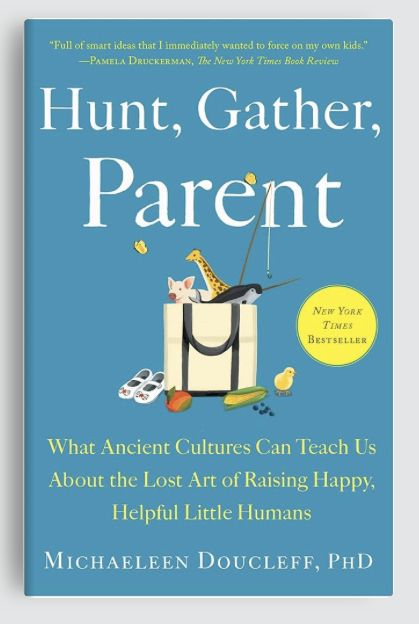
Michaeleen Doucleff’s first book “Hunt, Gather, Parent” seriously changed the way I parent for the better. (The subtitle is “What Ancient Cultures Can Teach Us About the Lost Art of Raising Happy, Helpful Little Humans.”)
Most parenting books leave you confused, grasping to remember the million rules they laid out, and feeling like you’ve already screwed-up your kids forever. This one gives you just two main ideas to implement into your daily life, and they’re easy to remember.
Author Michaleen Doucleff studied three ancient cultures (the Maya, Inuit, and Hadzabe) whose children are still happy and helpful, and boiled it down to two important things:
- Let your children help.
- Don’t yell at your children.
Pretty easy? Right?
Well……neither one is easy at all, but they’re certainly easy to remember. And once you implement them, they’re truly life changing.
Hear a quick review of the best points while you’re walking, or doing dishes, or commuting to your job!
Anti-Dopamine Parenting Is The New Black
This book gave me permission to stop going to the overstimulating, overpriced arcade and let the kids play outside or help me around the house.
This book told me that it’s ok for us to do things that are not “child-centered,” but instead have kids do actual work! Let’s face it, our kids will eventually need to wash a dish or plunge a toilet, so let them follow you around and learn life skills! Little kids think it’s fun! (No seriously, they do.)
I don’t know about you, but I was SO sick of being my children’s full time “cruise director.” We were spending every moment of our free time going to ballet class, or the play date with the mom I didn’t particularly enjoy, or the trampoline park that felt more like a rave than a playground.
Doucleff agrees, stating, “I never really enjoyed these activities. Saying it makes me feel like a bad mom, but it’s true. At “kid-friendly” places, I was either completely bored or utterly overstimulated by the noise, light, and chaos.” She confesses, (to my relief) “Playing at home with Rosy in the living room wasn’t much better. Some afternoons I’d rather have stabbed my eyes out than play another session of Princess Elsa and Anna. But I told myself, This is what a good mother does.” Girl, I feel you!
I’m hoping that her new book “Dopamine Kids” has some similarly hopeful advice.
Let Your Children Help
The first thing that Doucleff realized by researching ancient cultures is that they let their children help. Not just having junior use the toy vacuum while you do the real thing, but actually contribute.
I’m sure you have noticed how toddlers always want to help. (“I can do it myself!”) So let them! They might break a dish while unloading the dishwasher, but this is how you make “happy workers.”
Have you heard yourself say this: “Let me do it because it will go faster. You go play.” Well, you were teaching your child that their job is to play (or ipad) while you work. No wonder they don’t want to help out once they’re 14! But it’s not too late. Let your teens help with dinner or grab that book from the high shelf. You can still make a helpful human!
Our children learn how to become adults from us. If we don’t teach them the ins-and outs of adult life, then somebody else will. And in the current culture, anything we don’t teach them, they’ll probably learn from some yahoo on Tik Tok.
So bring your dopamine kids along to fill the car with gas. Give them a chance to push the lawn mower. Let them help you make the breakfast pancakes. Not only does this give them the skills of life, but it instills confidence and a sense of purpose. Doucleff writes that, “By welcoming children into the adult world, you confirm that they belong on the family’s team. Metaphorically, you’re giving them a membership card that they carry around in their back pockets. And that card offers full access to the benefits – and responsibilities of the team. This card tells the child, I do what the adults do because I’m part of the group. When the family does laundry, I do laundry. When the family cleans I clean…. You name it, the kid will follow.” Plus, it’s fun!
Don’t Yell At Your Kids
Yes, that’s right. Doucleff learned through her research that most cultures (aside from the US) don’t yell at their children. I too thought this sounded like the most impossible feat attempted by humankind.
Each night as bedtime crept nearer, I would steel myself for the UFC cage-fight that was getting my two small sons through a bath, into pajamas, and into our reading chair with clean teeth. In our house, the process took almost two hours. There was yelling, crying, stalling, running around, chasing, more yelling, more crying, and more cuss words than I’d like to admit.
When I read in “Hunt, Gather, Parent” that I wasn’t supposed to yell, I thought it was a good laugh.
But then I tried it.
I used Doucleff’s two main suggestions:
- Stop talking. (Walk away if you have to.)
- Learn to have less, even no anger.
We westerners tend to talk. A lot. And when I was trying to get my kids to bed it was an avalanche of, “Hold still! Why are you doing that? You know better than that. Hurry up. Get back here. If you don’t brush your teeth by the count of three….” And so on.
And I will admit, it wasn’t working. So one night, I decided that I was going to try to complete the bedtime routine without raising my voice once.
And it was hard. Really hard.
One thing that helped was Doucleff’s suggestion that sometimes you just need to walk away. If you’re finding your blood pressure rising, or feel the need to bark demands at your kids, just turn your back or walk away.
When you find yourself thinking, “I just want to sit on the couch with a glass of wine and these jerks can’t even put on their pajamas without causing a scene…” just take a breath. When you feel the anger first coming on “You can leave the room. Get out of the car. Walk down the sidewalk. Walk across the park. Or simply turn your back on the child.” Doucleff explains that “distancing can also help communicate to the child in a calm way that their behavior, at that moment is unacceptable. Ignoring children makes a powerful tool for disciplining.”
So that night, every time I felt like yelling, I either turned my back or walked into the other room. I kept my calm. And my children reacted in a way I never expected. They calmed down too. They stopped running, they stopped yelling, and they stared at my quiet face waiting for my next move.
If you’d like to read even more of my review of “Hunt, Gather, Parent,” please check out this link. It goes into even more detail so that you can become a parenting pro, even if you don’t have the time to read an entire book before the baby wakes again.
Again, this book truly changed the way I parent, and I’m really looking forward to reading Doucleff’s newest book “Dopamine Kids” which will tackle both screen time and junk food. Yessss!
Subscribe to my Substack!
More Resources For Anti-Dopamine Parenting
Should I light my child’s iPad on fire, or grind it in the garbage disposal? Asking for a friend…
Why are kids so addicted to screens? Hint: It’s by design
How Money and Mania are Ruining Kids’ Sports
Why is play important for children?
Family dinner doesn’t have to be a disaster
You Could Learn A Lot From an Oompa-Loompa
Amazing Books, Other than Dopamine Kids…
Disclosure: I am an affiliate of Bookshop.org and I will earn a commission if you click through and make a purchase.” to your website or post. So aside from Dopamine Kids, you can get books for everyone on your list!
Let Us Know What You Think About Dopamine Kids!