Is Online Misogyny Filling a Void That Parents and Society Have Been Neglecting? What Parents of Boys Should Know
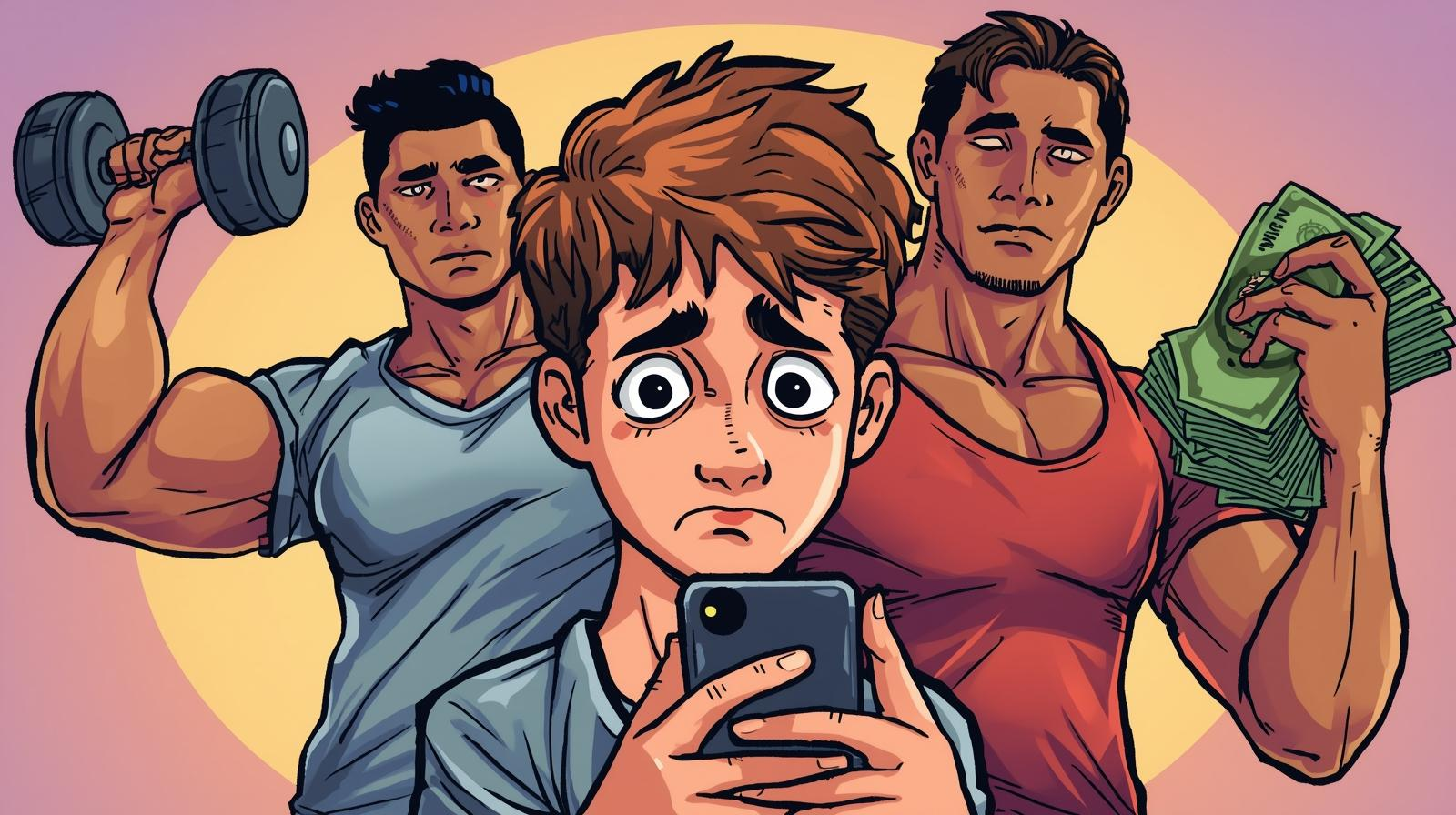
I only recently learned what “the manosphere” is, and I’m not alone. Many parents have heard the word once or twice, but don’t really know what it entails. I now realize that the hateful online rhetoric being targeted at young men hurts our sons AND daughters. We need to know how to identify it, why it’s attracting boys across the world, and what our sons need from us to combat its influence.
What is the manosphere?
The “manosphere” is an umbrella term for the rising trend of bloggers, YouTubers, and memes that spread a misogynist worldview, especially among young men who feel lonely or insecure. Their messaging claims that it helps boys, but it ultimately promotes harmful gender beliefs, emotional suppression, and dominance over women.

There are a few subgroups of the manosphere including: Incels (Involuntary Celibates), Pick-Up-Artists, Men’s Rights Activists (MRA), Men Going Their Own Way (MGTOW) and Red Pill ideology.
The most famous of the manosphere is Andrew Tate, a former kick-boxer who was arrested and accused of charges including rape, assault, and human trafficking. (What?!!!) He is banned from numerous social media platforms due to racist, misogynistic, and homophobic rhetoric. Tate runs online courses including “Hustlers University,” which many accuse of being a pyramid scheme. So yeah, I’d like my sons to stay about a billion miles away from this creep.
SOME OF ANDREW TATE’S MOST OFFENSIVE QUOTES INCLUDE (but are not limited to!):
“A woman’s value is directly proportional to her beauty and femininity.”
“A woman’s worth is determined by her ability to please and satisfy a man.”
“I have everything every man has ever dreamed of. I got a big mansion, I got super cars, I can live anywhere I want, I got unlimited women, I go where I want; I do anything I want all the time. So, I’m an amazing role model.”
How Boys Get Sucked In To the Manosphere
It’s not like your 12-year old boy wakes up one day and decides to be a woman hater. As Julia Storm explains on Screen Less Play More, most boys are able to recognize vitriol when they see it. If they are in a thoughtful home or school that introduce multiple viewpoints, they won’t instantly gravitate towards backwards ideology. However-

“What concerns me more,” says Julia, “is the way that some of these, more sort of like retro, misogynistic, ‘anti-woke,’ belief systems are threaded into videos by influencers and and streamers that boys love to watch because they’re funny, or because they’re great entertainers, or because they have some positive tips, right? So, they might be watching someone who’s a streamer who they really enjoy and maybe they also, let’s say, talk about, I don’t know, they’re taking care of your health, right? And like working out and being strong.
“But then all of a sudden it sort of slips into these ideas and rhetoric around what a man needs to be…and this very sort of narrow definition of manliness. And from there, there’s many ways that that can go. I mean, that can just go to how you should treat a girl or a woman, what her place is in the world, in your life, who should be in charge. Or it can go to much darker places where there’s a lot of hatred being spewed against women, sort of suggesting that all the issues that men are having in our society can be blamed on the advancements that women have gained.”
Misogynist Radicalization Often Begins With Memes
Julia Storm tells Screen Less Play More that younger boys are often introduced to the misogynistic views of the manosphere through memes. They are not yet old enough to care about videos about fitness or dating, but they may trade memes with friends that are homophobic, misogynistic, or racist, couched as jokes. Boys may think the memes are silly or funny at first, but sometimes the messaging sinks in and they start believing the fringe ideology.
Popular meme themes include:
- Women say that looks don’t matter but they only date attractive men.
- Women are worthwhile only if virgins, but promiscuous men have high status.
- Photos of famous men with quotes like “Feel nothing. Focus on money.”
- Two panels: a woman doing something and a man doing the same, with captions claiming society treats women better.
- Feminism ruined everything: Before/After comparisons of an old-fashioned housewife vs. modern woman on her phone.
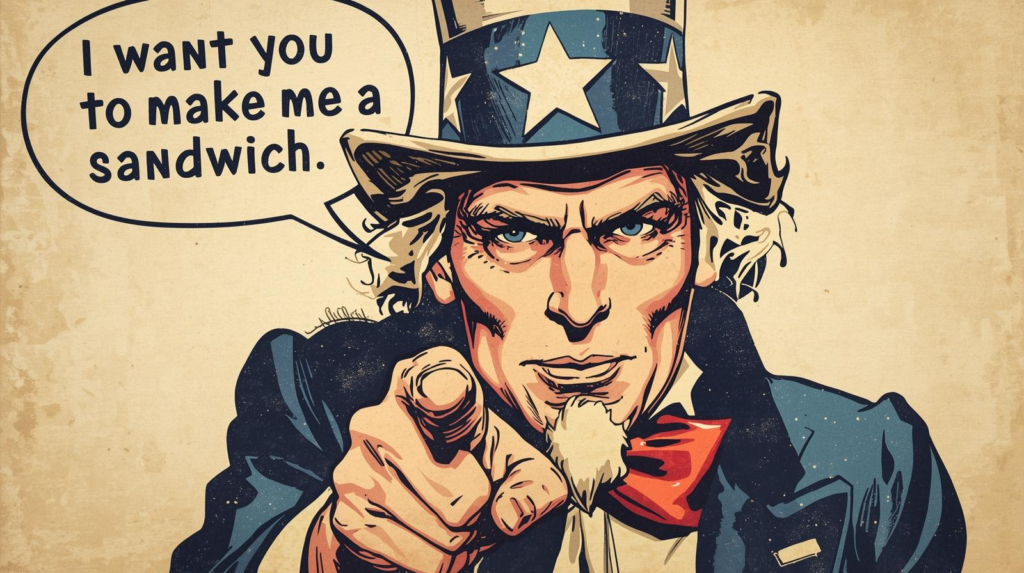
- Jokes that a woman’s place is in the home or kitchen.
Beyond Andrew Tate – Who Is In The Manosphere?
Who are the misogynistic players attracting young men into their rhetoric? And why? Here are some of the key players, and why teens end up seeing their content.
| Name | Platform Presence | Why Teens End Up With Their Content |
|---|
| Sneako | YouTube / Rumble / podcasts | Presents himself as “just asking questions” → draws boys into ideology. |
| Fresh & Fit (Myron Gaines & Walter Weekes) | YouTube livestreams | Uses “debates with women” as emotional spectacle → very persuasive to insecure boys. |
| Rollo Tomassi (author of The Rational Male) | YouTube + books | Provides pseudo-scientific arguments that feel like “truth.” |
| Pearl Davis (Just Pearly Things) | YouTube shorts | Promotes “traditional femininity” and antagonistic gender debate. |
Influencers Adjacent to the Manosphere (which can serve as a “gateway” to more toxic content
Joe Rogan – He hosts “everyone“, including manosphere figures and counterpoints. Teens see him as a neutral “truth-seeking” older brother figure, which can make harmful guests’ views feel more legitimate.
Adin Ross – High-energy streams feel like hanging out with friends. He frequently hosts manosphere guests (including Andrew Tate) which normalizes those men to young audiences.
IShowSpeed – His intense, exaggerated emotional reactions are entertaining to tween/teen boys. Algorithm places his content next to Ross/Tate content due to overlapping viewership.
Theo Von – Relatable storytelling and emotional openness make him feel safe and funny. His podcast occasionally hosts controversial or manosphere-adjacent figures making those ideas seem “part of normal conversation.”
Logan Paul – He represents a cool, high-confidence lifestyle teens admire. He frequently features controversial male influencers or body-optimization culture, which can funnel viewers into more extreme creators.
Listen In To Learn More
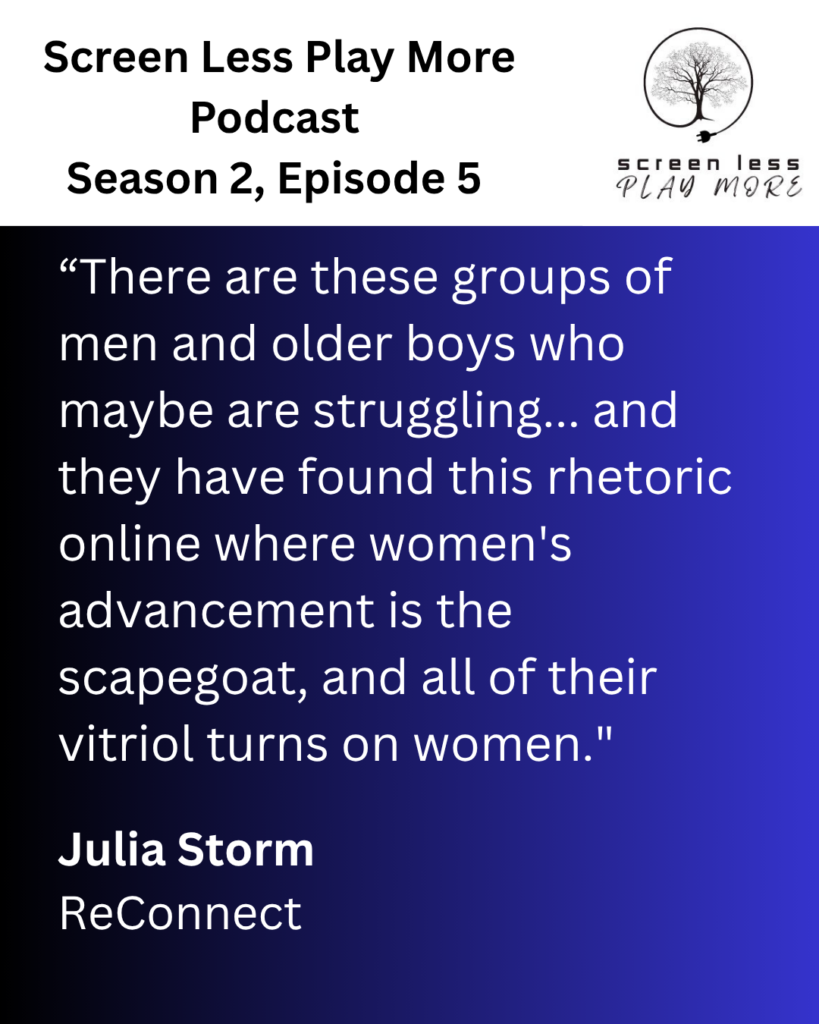
Julia Storm of ReConnect tells the Screen Less Play More Podcast about the main players in the manosphere, why they’re attracting young teens, and lots of practical ways we can steer our kids away from this toxic rhetoric.
How Did We Get To The Manosphere?
What caused so many young men to feel such a void that they are being swayed by hateful rhetoric? Well, it’s complicated. Much of the change in society has happened gradually. For centuries men’s role was that of provider and protector, women’s role was that of mother and nurturer. With the emergence of feminism in the 20th century, the narrative for women expanded to a much wider choice of roles. Unfortunately, society did not change the narrative for men, leaving them wondering what their role is in a post-feminist society. This confusion of identity is compounded by some men’s difficulty in the education system, lack of economic opportunity, social disconnection, failure in modern dating, and over-reliance on modern technology.
NYU Professor Scott Galloway explains the many reasons very succinctly in this clip from The Today Show. He has an excellent podcast on this topic called “Lost Boys” that I highly recommend.
Women and Girls Are Succeeding More in Education
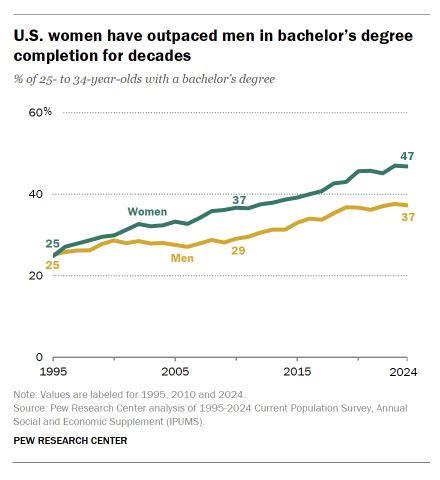
Boys are falling behind academically, starting in elementary school. Anyone who has ever raised boys, or frankly, been in the same room as a boy, knows that they are not fond of sitting still. But what are they asked to do all day long at school? Sit still, be quiet, pay attention. Some boys do fine in this environment, many do not.
A 2017 study found that the more time first graders spent sitting, the fewer gains they made in reading and math in the two following years.
The gap widens at college, where women earn more degrees than men. According to Pew Research in 2024, “47% of U.S. women ages 25 to 34 have a bachelor’s degree, compared with 37% of men.”
Some people suggest “redshirting” boys so that they don’t begin kindergarten until six. This would give them an extra year of development, theoretically helping them to perform better in school and be more on-level with their five-year-old female classmates.
As you would guess, struggling at school isn’t great for your social life, your job prospects, your earning potential, or your self-esteem. Which brings us to changes in the job market.
A Changing Job Market
Remember when there used to be shop class, home-ec, and auto mechanic class? Me neither. That’s because many schools got rid of job-prep classes by the mid-90s. That means that the less academically-leaning kids haven’t had a way to hone those skills in high school for almost 30 years. And many boys are struggling to get jobs without this hands-on training.
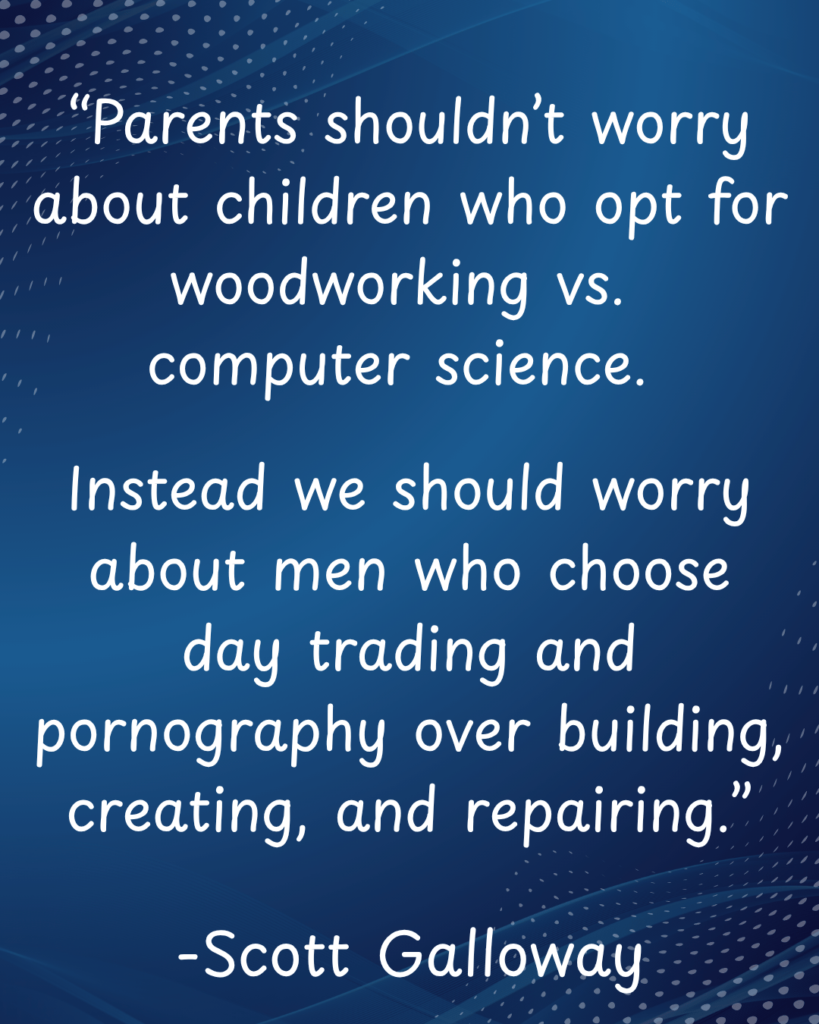
The economy used to reward physical strength and middle-skill jobs. Now it rewards communication, emotional intelligence, and higher education – all areas where boys receive less support.
Additionally, the middle class is shrinking. Scott Galloway talks about this at-length on his various podcasts. He states, “Everything we do is ‘how do we buttress the wealth of incumbents and old people and make it more expensive for young people? Their housing has gone up 4×, their education has gone up 2× and, on an inflation-adjusted basis, their income has gone down.”
As a result, many young men feel that there’s no clear path to economic security, and feel validated by the messaging of the manosphere.
Social Disconnection and Loneliness
All of society is less social than it used to be, but especially men. The Pew Research Center finds, “Roughly equal shares of U.S. men and women say they’re often lonely; but women are more likely to reach out to a wider network for emotional support.”
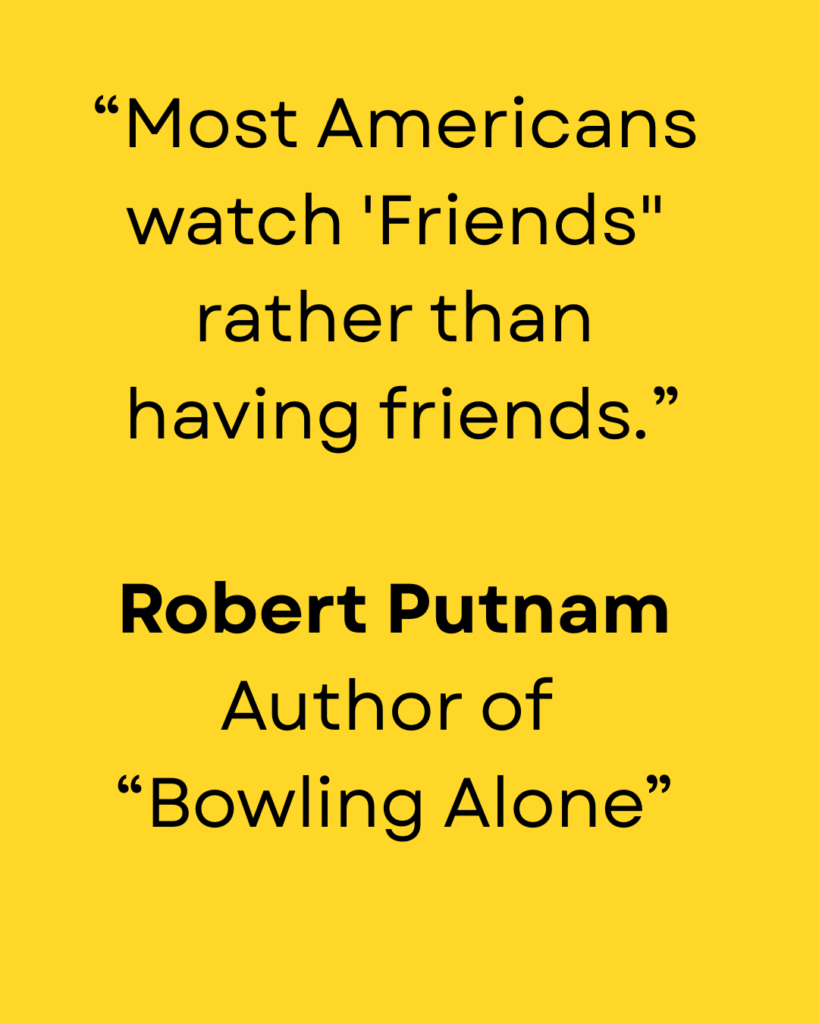
Long before the Manosphere, Robert Putnam’s book “Bowling Alone” came out in 2000. It was already saying then that Americans weren’t engaging socially like they used to. Americans of the 20th century used to spend more time with family, neighbors, classmates, and clubs than they do now. Boys were in Boy Scouts and played in the neighborhood. Men went to the local VFW post, the Rotary Club, Kiwanis Club, or bowling league.
Robert Putnam states, “The dominant theme is simple: For the first two-thirds of the twentieth century a powerful tide bore Americans into ever deeper engagement in the life of their communities, but a few decades ago—silently, without warning—that tide reversed and we were overtaken by a treacherous rip current. Without at first noticing, we have been pulled apart from one another and from our communities over the last third of the century.”
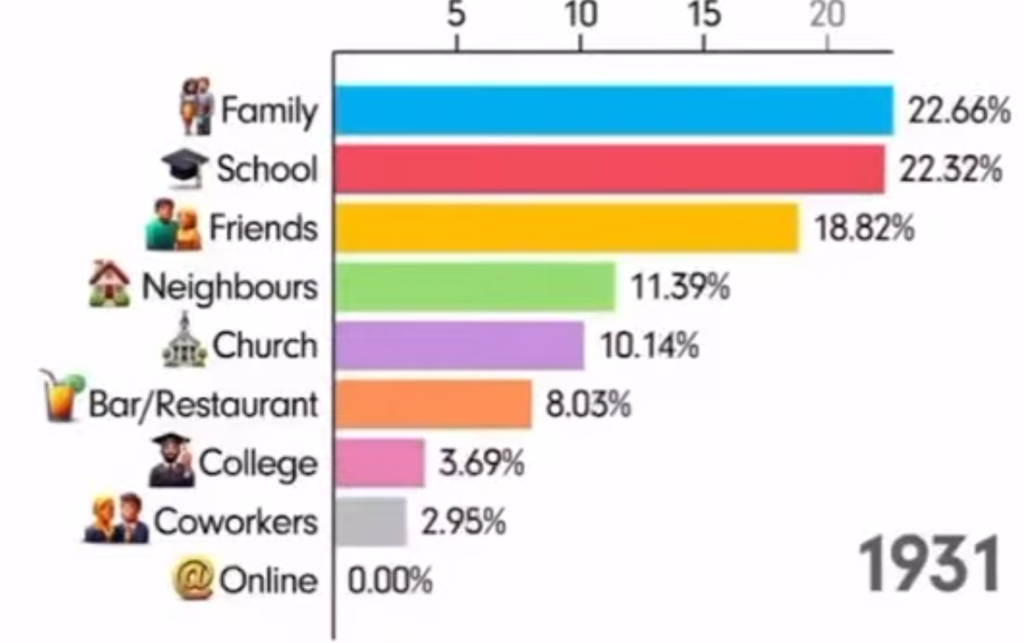
You may have seen this video/meme online, showing how the time of Americans has changed vastly through the past century. The difference is striking.
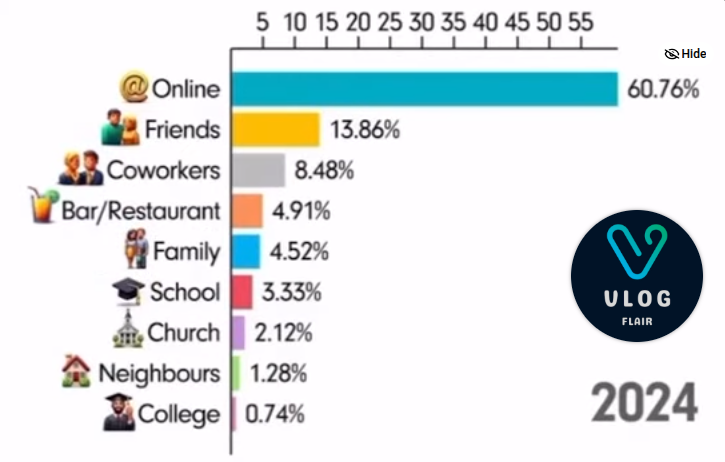
Manosphere fuel: Social Life or Social Lack?
The change in pastimes towards disconnection was already happening in the ’80s and ’90s, but the internet and smartphones hastened the loneliness like vodka on a campfire. Why would young men want to make the effort to go bowling or hiking, (or dating) when you have high resolution porn, social media, and video games? Social media hasn’t made us more social AT ALL. It has taken a generation of kids and and turned them into dopamine addicts, who spend more time staring at the videos of strangers than interacting with their friends or family.
And don’t even get me started on video games! There are countless young men, wasting away in parents’ basements, addicted to Fortnite and Call of Duty. Richard Freed wrote an incredible book about the addictive nature of video games and social media called “Better Than Real Life.” Dr. Freed explains to our podcast that video games are designed to addict by targeting the primal wiring of humans, especially boys. The most effective games of this sort are Fortnite, Call of Duty, Minecraft, and World of Warcraft.
“This little modern world that we live in is completely different from the four million years that we lived essentially all in the same environment, all across the world. And that is, to be a boy, you needed to do two things…And that is: to hunt or fight, and to build shelter,” says Dr. Freed. “What are the two things in Fortnite that you essentially gain points for? Hunt, fight, and build shelter.”
“That is not a game. That is a machine that is designed to target your kid’s DNA to go down to their soul,” warns Freed.
Dr. Freed says, “So you have a generation of boys growing into young men, feeling like they’re sometimes happy…. ‘I haven’t got a job. I kinda didn’t do very well in school or I failed out. I’m living in my parents’ house. I have no prospects of kind of moving forward, but I sure feel like I’m competent. I sure feel like I’m with my tribe of boys [in my game.] Some boys wake up to go, ‘God, what have I done?’ Some boys just don’t.”
The Manosphere and Love: Dating Apps Have Created a Winner-Take-All Market
Another aspect of loneliness affecting young men is their lack of love interests. Scott Galloway often cites that on dating apps the top 20% of men get 80% of the attention. Thus, if they can’t look impressive within a few seconds, women will swipe left and the average man concludes that he is worthless.
This idea of feeling unwanted is espoused by the Involuntary Celibates (Incels), an online subculture of the manosphere who identify as being unable to find a romantic or sexual partner despite desiring one. The ideology has been linked to real-world violence and domestic terrorism. Several mass killings have been carried out by men who identified with incel culture and cited the movement’s beliefs as justification for their actions. It is reported that law enforcement monitors incel forums due to the prevalent violent, misogynistic rhetoric and the potential for real-world harm.
Part of the problem lies in the fact that men are using dating apps at all. A 2023 study by Date psychology found that 45% of men aged 18-25 have never asked a woman out in person. This is attributed to increased risk aversion, availability of dating apps, and anxiety about in-person socializing. And I would add, lack of opportunity for in-person connection when some men are choosing to stay home instead of join a house of worship, sports club, service organization, or even go to the bar with co-workers. It’s pretty hard to meet someone who interests you romantically when the only people you see are the UberEats delivery guy and your AI avatar.
The Manosphere’s Impact On Young Women

Aside from the obvious fact that Mysogyny and anti-feminism are not good for any women, it’s especially important to keep “manosphere” messaging from brainwashing your daughter into thinking that it’s “just the way the world works.” Millions of women have fought for centuries to push the United States towards a more just and equal society on the basis of gender. On the most basic level, we don’t need our tween and teen women believing that their career goals are unattainable because they saw a bunch of memes saying that their place was “in the kitchen.” On the more destructive level, we don’t want women to believe that violence against women is in any way acceptable or “romantic.”
A couple of months ago, I made a fake Snapchat account under the guise that I was a 15 year-old girl. A few minutes into the “spotlight” feature I encountered a video that suggested that boys “push her up against the wall, kiss her and tell her she’s pretty. It’s what every girl wants. Just find the courage and do it bc they aren’t gone tell you.”
You read that right. It’s suggesting that you just push a girl against a wall and kiss her. In the world I inhabit, that is considered assault. No grown person is doing that unless they want to get slapped or arrested. However, Snapchat wants this 15 year-old to think it’s commonplace, or romantic.
It’s not just young men being inundated with inaccurate and offensive memes and videos about the role of women in society. If girls see this content too often without being informed of it’s invalidity, they may fall for it just as hard as the boys do.
What Can Parents Do To Protect Kids From The Manosphere?
Let’s start with the technical side.
First off, if you are the parent of a younger child, keep them off of YouTube and social media as long as possible.
Personally, I’m not ever going to allow social media in our home, however I do allow a small amount of Youtube. But I am extremely vigilant that they watch only pre-approved videos, and NEVER click on videos that the algorithm suggests.
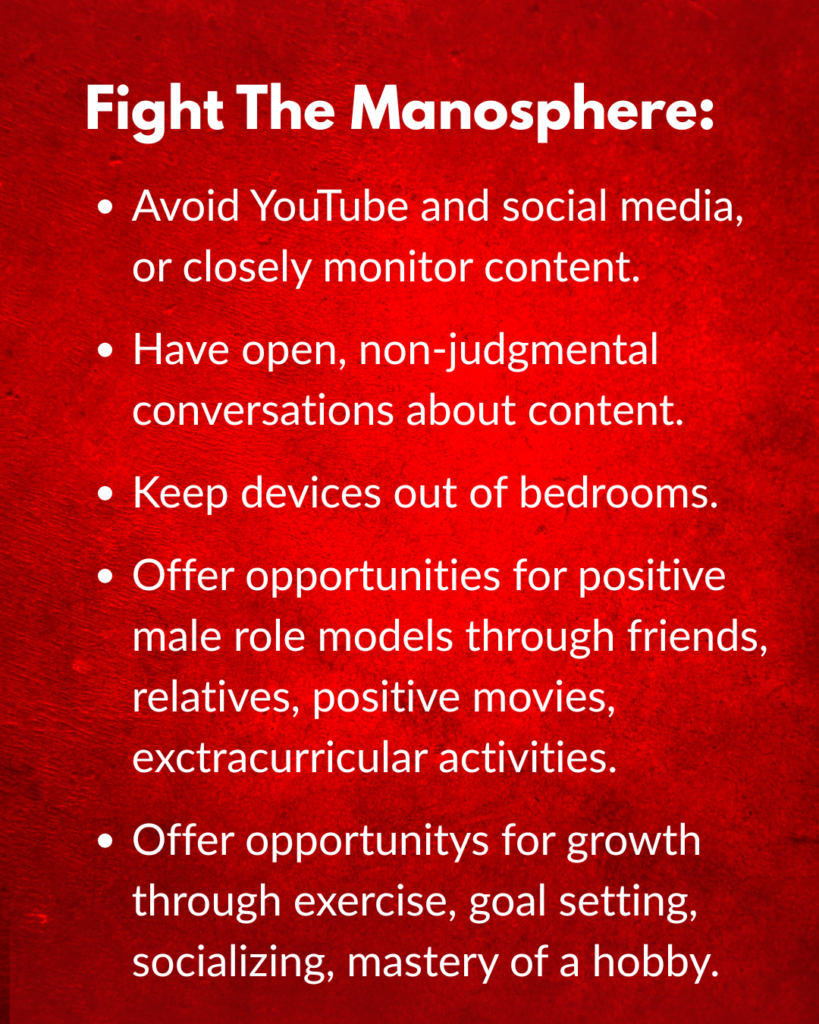
At our home, my boys (ages 7 and 10) are allowed to watch one hour of YouTube per week on Friday afternoon when they get home from school. It is done on the enormous television screen in the living room so that everyone in the house can see and hear what is being watched. I stay within earshot, and if I ever hear anything objectionable, I pop my head into the room and determine if I want them to change the channel or not. There are very few channels I have approved- mostly videos of people assembling Lego sets, educational videos like Mark Rober and Jared Owen, and Mr. Beast (to my chagrin.) If they click on anything other than the pre-approved, then YouTube time is done for the week.
If your child has access to YouTube or social media, talk to them about what they watch. Julia Storm suggests, “I would co-watch sometimes and I would try to approach it with open-mindedness, even though that can be really hard for us… When you sit with your child and you watch in a way that is a little bit more open-minded and they don’t feel instantly judged, they’re just much more willing to share things with you and have a conversation.”
These same conversations can be held about memes that they share or jokes that they tell in your presence.
Questions to ask kids about Manosphere-style content:
“What do you like about this guy’s videos?”
“What do you think makes him so popular?”
“Do you think everything he says is true, or do you think he exaggerates sometimes?”
“What kind of people do you think he’s trying to reach?”
“How do you think he treats women — and what do you think about that?”
“Does he ever say things that make you uncomfortable?”
“How do you feel when you watch his videos?”
“Does it make you feel more confident, or more angry, or something else?”
“Do you think his message helps guys your age feel better about themselves?”
“If you said those things out loud at school, how do you think people would react?”
“Are there other creators who talk about being confident or successful in a different way?”
“What does being a good man mean to you?”
“Can someone be strong and respectful at the same time?”
“Who else do you think gives good advice to guys your age?”
If They Push Back or Defend the Content: (Keep the conversation open, and non-judgmental. It doesn’t need to be a debate.)
“Yeah, I get why that might sound cool — some of what he says does sound empowering. What parts do you think go too far?”
“I can see the appeal — he’s confident and bold. Do you think he ever crosses a line?”
“What do you think people mean when they say his content is controversial?”
Solutions to the Manosphere: How Parents Can Fight Back
I think that this all begs the question; what are boys NOT getting from society and parents which leads them to accept advice and camaraderie from complete strangers?
Friendships

As mentioned earlier, society as a whole is getting less social. And though that’s not good for anyone, it’s especially bad for adolescents who are forming their belief systems and forging same-age friendships. As much as you can, fight for IN REAL LIFE friendships and events. Be the house that has ping-pong and pizza on Friday night. Invite your child’s friends over for a weekly game of Dungeons and Dragons. Host phone free slumber parties, nerf gun battles, or paint-balling.
Extracurriculars are important for forging friendships. Don’t opt for short-term activities where you are with a group for only a few weeks. Try to find long-term activities like Scouting, 4H, swim team, music programs, religious youth groups, or robotics teams where your child will be seeing the same kids for years (and hopefully creating life-long friendships.)
Role Models
As NYU Professor Scott Galloway states, boys need an “aspirational vision of masculinity.” Show boys that there is an alternative way to be a strong, kind, responsible, man. Julia Storm suggests on our podcast, “Who are the good men in our lives? Who are the men who are, you know, stand-up guys who live their life with integrity…How can I get my kid in front of those guys a little bit more often? And, you know, maybe it’s on a regular basis, but maybe it’s just now and then.”
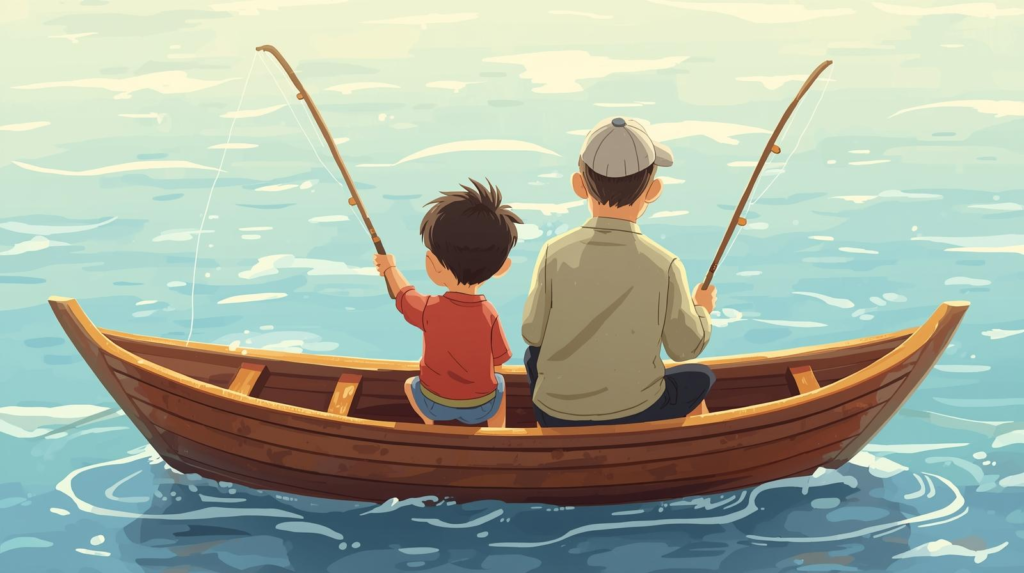
If you don’t have a positive male role model in your home, seek them out in teachers, coaches, uncles, grandparents, or mentors (through organizations like Big Brothers Big Sisters.) And keep in mind that there are all sorts of positive examples of how to be a man. You can have role models in your life who are straight, gay, trans, artsy, athletic, religious, secular, and racially diverse. Part of what makes the manosphere toxic is the message that all men must fit one specific mold.
It’s also important for adolescent men to see positive examples of how to treat women. Offer examples every day of being kind, using respectful language, refraining from violence, and working as a team. One way to bring it home is to ask “would you want someone treating your mom or sister that way?”
I think the most important thing to remember about role modeling was said perfectly by our podcast guest Julia Storm. “Girls need to see themselves as doctors, as lawyers, as pilots in order to believe that they can be that… kids of color need to see themselves in movies and in TV. And we know that now. We know that for children, representation is really important. And it turns out that it’s just as important for young boys, even white boys. They need positive representations or they’re just going to gravitate to the loudest voices.“
Hear Why Young Men Are Struggling Right Now with Oprah & Scott Galloway
Hope you learned what you need to know about the Manosphere! If not, listen to the entire interview with Julia Storm here:
More Resources on Kids & Teens, and How To Be An Amazing Parent!
Checkout my Substack! It’s definitely not the Manosphere 🙂
Snapchat Thought I Was 15. What It Showed Me Was Shocking.
Should I light my child’s iPad on fire, or grind it in the garbage disposal? Asking for a friend…
Why are kids so addicted to screens? Hint: It’s by design
How Money and Mania are Ruining Kids’ Sports
Why is play important for children?
Family dinner doesn’t have to be a disaster
You Could Learn A Lot From an Oompa-Loompa
I am an affiliate of Bookshop.org and will receive a small commission from your purchase, at no cost to you. Yay! https://diversebrainz.com/movies-for-sensitive-kids/ https://diversebrainz.com/homework-help-for-adhd/