Why Kids Need Dirt, Danger, and the Outdoors
You’re making dinner. One kid is yelling. Another kid is crying. Your partner just busted through the door from a long day at work. And suddenly….you’re done. Like, really done. Ready to go “Gone Girl” and never return again.
That’s exactly what happened to Josée Bergeron when she was pregnant, overwhelmed, and ready to run for the hills. She got in her car, turned off her phone tracker, and drove away.
The author of “Beyond The Front Door” drove to a frigid lake and just waded in. As the cold water surrounded her growing body, she realized that she and her family had completely disconnected from nature, and needed a way to return.
Many of us can relate. We want to get more nature in our lives, but don’t really know how. We are hamstrung by cities, schedules, and screens. But our podcast guest Josée Bergeron has some solutions that are easy, cheap, and fun.
Read on for more ideas, or listen to her episode of Screen Less Play More. Or both!!
Why Don’t My Kids Want To Go Outside?
What is keeping today’s kids and families from the great outdoors? We aren’t failing our kids on purpose, we are just up against some pretty massive modern forces. Josée argues that it’s three main things: cities, schedules, and screens.
Cities are eating up a lot of green space and replacing them with a concrete jungle. Many families live far away from forests, lakes, and even parks. Luckily, there are some quick, easy, and cheap ways to get more nature in your life, even if you’re a city dweller:
How To Connect With Nature in A City or a Suburb
If you can’t go into nature, bring nature to you! Try these parenting hacks to get more of the great outdoors into your great life:
- Read a book on the front porch. Take storytime onto the stoop!
- Eat one snack or one meal per day on the patio or in the backyard.
- No screens in the car – instead have kids look out the windows. Discuss the birds you see, the natural monuments you pass, and the stages of the seasons.
- Watch the sunset as a family.
- Put a bird feeder outside of your home window.
- Bring nature inside. Start a collection of keepsakes you found outside like feathers, rocks, pine cones etc. and put them on display for kids to touch, feel, and discuss.
Overscheduled Kids are Stressed Kids
Most of us have just way too much to do. And these days, we are keeping kids so busy that they rarely have time to play, relax, or spend time in nature.
In her book “Beyond the Front Door: Embracing Nature for a Happier and Healthier Family,” Josee Bergeron writes, “When parents were asked about the reasons that prevented them from getting outside with their children, lack of time was one of the most mentioned reasons. Between working, shuttling kids to school then extracurricular activities, making meals, and doing chores, families are overscheduled. While extracurriculars, also called enrichment activities, can be good for children, too much isn’t a good thing. Unfortunately, many children have no time left in their day for unstructured outdoor play or to be in nature, and neither do their parents.”
So what can we do to de-stress and de-schedule?
Stop Over-Scheduling Your Kids (and Yourself)
Do they really need to do baseball and piano and robotics and tutoring and soccer and dance? You might find that your stress level plummets if you reduce your schedule to one or two activities per week. You might notice that your kids have more time for free play, more time to unwind, and are able to be a little more independent. If we want kids to do more for themselves, we need to give them time away from “bossy” adults who tell them what do do every minute of every day.
Intentionally leave gaps in your day. That’s where creativity happens, where outdoor play happens, and when kids decompress.
If you need after school care, perhaps see if you can put your kids in a play-based situation where they have free reign to just PLAY. Instead of having them go to organized sports or lessons as “aftercare,” you might find a playgroup, a rec center, or a Timbernook. Your school’s “aftercare” program may also be a place that they can simply hang out with friends.
Use Tiny Moments Instead of Big COMMITMENTS
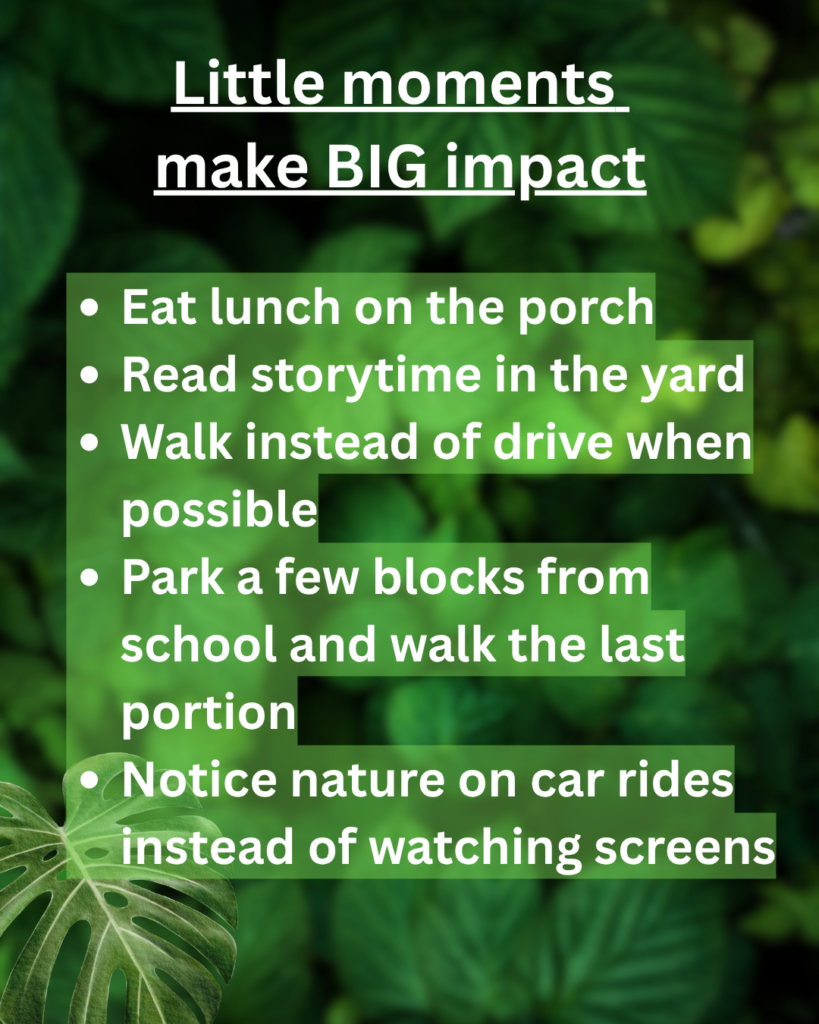
You don’t need a hike, a trip, or a big outing to get close to nature.
You can incorporate nature into your life by parking further away,
by noticing the clouds, by looking for birds, or sitting outside for a few minutes.
Even small moments of noticing nature with your kids can have a big impact.
It’s Not “All-or-Nothing”: How We Bike Half Way To School
You don’t have to take a long hike or a distant camping trip to reconnect with nature. Sometimes all that kids need to de-stress after school is to lie on the grass and find shapes in the clouds for five minutes. Sometimes eating snack at a park after school gives you the dose of green you need before heading to piano lessons or indoor gymnastics class.
Personally, I decided that I wanted my kids to bike to school, but it was too overwhelming to get everything ready in the morning. Thus, I decided that it didn’t have to be all or nothing. I decided we could do half.
In the morning, I drive my boys to school with their bikes in the trunk. I drop off their bikes at the school bike rack, and I head home in the car. That afternoon, I bike back to school myself, and accompany them home on their bikes.
Thus, we get a wonderful 30 minute ride through the beautiful open-space of our town, and their minds are clear by the time we hit our driveway. And, I didn’t have to leave the house 30 minutes early in the cold of the morning, or get them up 30 minutes earlier. Win! (And by the way, we don’t even do it every day. It all depends on the weather and our schedule. But, I figure that twice or thrice a month is better than never! Again, it doesn’t have to be all or nothing.)
You can do the same concept with almost any outing. Is the ice cream store a ten minute drive? You could park three blocks away and walk the very last part.
Is the chess tournament an hour drive away? You could put your scooters in the trunk and ride for the last ten minutes of the commute.
You get the idea.
Why Your Teen Suddenly Hates Nature (and What to Do About It)
Teenagers and tweens often lessen their interest in nature as they become more interested in peers, academics, and school activities. This is completely normal and common. But what can we do about it as parents?
Josee relates, “I have three teens right now, so I know that there’s an added layer of challenge because unlike little children, we can’t shuffle them out the door, right? It’s hard to do. I can’t really do that with my 200 pound teenage son. So I think one thing that’s really important that I share in my book is for us to really model what that looks like as parents.“
Instead of forcing the issue and nagging kids to get outside, parents can lead by example. Teens are highly attuned to hypocrisy, and are keenly aware if you nag them to spend time in nature, but then spend your own time scrolling Instagram on the couch. Instead, when parents consistently go outside for their own well-being, teens begin to see that time in nature has real value and isn’t “just for kids.”
Getting Your Teenager Outside More: Don’t Insist – Invite
One strategy parents can use to get their adolescents into the outdoors more often is to focus on connection. Create opportunities that feel collaborative rather than controlling. Figure out something that your teen already enjoys, such as grabbing a fancy coffee, taking photos, or mushroom hunting (a hobby that Josee’s son is into!) Invite them to walk to the coffee shop with you. Ask if they want to walk around a lake and take photos of local birds. Or invite them to do a new and unique hobby with you! (You can bond while you learn!)
A few outdoor hobbies that teens might enjoy include:
- Beekeeping
- Astro photography
- Caving
- Sand art
- Rock climing
- Live Action Role Playing
- Disc Golf
- Geocaching
- Mushroom hunting
- Falconry
- Birdwatching
- Oil painting
- Boating or waterskiing
- Insect taxedermy
- Historical reinactments
By tapping into what genuinely interests them, nature becomes a backdrop for something they care about instead of a chore. Even if teens push back at first, many will later admit that they enjoyed the experience and want to do it again.
Another key strategy is to talk openly about the benefits of being outside, such as improved mood, better sleep, and reduced stress. This way, teens can begin to internalize these habits for themselves. This is especially valuable as they prepare for independence, giving them tools they can use later in life.When they feel depressed in their dorm room, hopefully they’ll remember that they usually feel better after getting some sunshine, spending time near water, or exercising outside. Build the habits now that will benefit them throughout life!
Just keep trying! Don’t give up on your teens. Consistency is key.
Josée wisely reminds us that, “If they were children who were quite connected to nature in their younger days, there’s a very good chance that they will come back to it.”
Hear my entire interview with Josée Bergeron here!